When we visualise the cities of tomorrow, our minds often gravitate towards sweeping architectural marvels, solar-glass skyscrapers, lush urban canopy networks, and silent, autonomous passenger vehicles moving along clean-energy transit corridors. We picture vibrant, human-scale pedestrian boulevards where nature and high technology exist in seamless balance. Yet, beneath this polished exterior lies a complex, less visible, but fundamentally critical network that keeps the metropolis alive: urban freight.
The movement of goods – from the timber and low-carbon concrete required for eco-friendly construction to the fresh organic produce delivered to local markets and the millions of e-commerce parcels arriving at our doorsteps daily – is the physical circulatory system of the modern city. As our urban centres grow increasingly dense and technology-driven, the way we manage the movement of physical items will dictate the functional success and environmental performance of our future built environments.
Ignoring urban freight when designing future cities is akin to building a advanced building without plumbing or electrical conduits. To unlock the full potential of tomorrow’s urban spaces, we must integrate clean technology, green infrastructure, and intelligent logistics planning into the very core of city design.

Defining the lifeblood of the metropolis: What urban freight entails
At its core, urban freight refers to the movement of goods into, out of, and within an urban area. While the average city dweller might associate logistics primarily with courier vans dropping off online shopping orders, the reality of urban freight is far more expansive and operationally complex.
Urban logistics encompasses several distinct sectors:
- Business-to-Business (B2B) replenishment: The daily delivery of inventory to retail shops, commercial offices, hospitality venues, and medical facilities.
- Business-to-Consumer (B2C) operations: Rapidly growing e-commerce fulfilment, grocery delivery, and on-demand parcel courier services.
- Construction logistics: The transport of heavy raw materials, structural components, and soil into and out of urban development sites.
- Waste and resource management: The systematic collection of commercial, residential, and industrial waste streams, alongside organic matter and recyclable materials.
- Reverse logistics: The return of surplus, re-usable, or end-of-life products back up the supply chain for processing or recycling.
This ecosystem involves a wide array of vehicles, ranging from heavy articulated trucks and refrigerated lorries to light commercial vans, cargo bicycles, and autonomous ground droids. To support this movement, cities require an interconnected physical network of distribution hubs, urban consolidation centres, micro-fulfilment depots, and kerbside loading zones. Understanding the full scale of urban freight makes it clear why managing these flows is vital to the operational and environmental health of any major city.
Ron van Duin, applied research professor of Port & City Logistics at Rotterdam University of Applied Sciences and assistant professor at Delft University of Technology, Faculty Technology, Policy and Management, explained urban freight as organising our daily needs in episode 452I on the What is The Future for Cities? podcast:
The spatial paradox: How urban planning intersects with freight
The relationship between urban freight and urban planning is defined by a persistent spatial paradox. Cities rely on a continuous inflow of physical goods to function, yet traditional city planning has often treated freight as an afterthought, prioritizing passenger transport and residential real estate over logistics space.
Over recent decades, surging land values in inner-city areas led planners to rezone industrial land for residential and commercial uses. Consequently, distribution centres were pushed out to the far edges of metropolitan regions – a process known as ‘logistics sprawl’. While this freed up inner-city land, it vastly increased the distances delivery vehicles must travel to reach consumers. Long journeys from fringe distribution hubs raise total vehicle kilometres travelled (VKT), worsen traffic congestion, and increase wear on road networks.
At the same time, the boom in e-commerce has fragmented traditional retail supply chains. Rather than delivering a single large shipment to a high-street store, logistics providers must deliver thousands of individual packages directly to separate residential addresses. This shift puts immense pressure on local neighbourhood streets that were never built for high-volume delivery traffic.
Modern urban planning must resolve this tension by integrating logistics into the built environment. Future city frameworks are moving towards mixed-use zoning that incorporates light industrial, green logistics hubs, and micro-consolidation facilities directly alongside commercial and residential districts. When freight infrastructure is planned as a core urban utility, logistics can operate quietly and efficiently alongside high-density living.
This connection between urban logistics and urban design was debated in episode 451R of the What is The Future for Cities? podcast:
Bottlenecks and gridlock: Existing and emerging challenges
The clash between expanding delivery demand and limited city space has created severe operational and environmental friction.
Kerbside friction and space scarcity
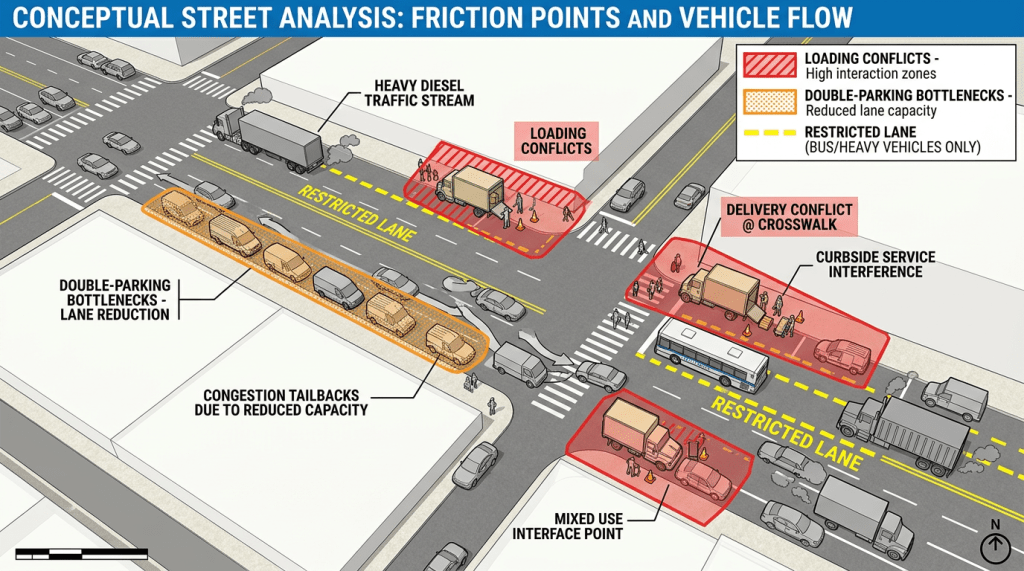
The kerbside is among the most contested real estate in modern cities. Delivery vehicles must compete for space with private cars, ride-share pickups, outdoor dining parklets, bus lanes, and cycling infrastructure. Inadequate loading zones often leave delivery drivers with no choice but to double-park or circle blocks repeatedly, blocking traffic lanes, impeding public transit, and creating safety hazards for cyclists and pedestrians.
Grid constraints and charging infrastructure
As delivery fleets transition from internal combustion engines to battery-electric power, cities face a major energy infrastructure challenge. Charging hundreds of commercial electric vehicles (EVs) simultaneously requires massive amounts of power. Many urban electrical grids lack the capacity or transformer infrastructure needed to support rapid megawatt-level charging hubs in inner-city industrial pockets.
Last-mile inefficiencies
The last mile – the final leg from a local depot to the consumer – remains the most expensive, inefficient, and energy-intensive part of the logistics chain. Delivery drivers in high-density areas spend substantial time dealing with locked apartment gates, waiting for service lifts, or making multiple delivery attempts when recipients are away.
Environmental and acoustic burdens
Conventional freight vehicles relying on fossil fuels contribute significantly to urban air pollution through tailpipe emissions and brake dust, while engine noise disrupts residents in high-density areas. These noise impacts often prompt municipal authorities to place night-time curfews on freight movements, which paradoxically forces heavy delivery trucks back onto the roads during peak daytime traffic hours.
Reimagining the flow: Existing and emerging solutions
Addressing these complex challenges demands a combined approach using advanced spatial design, clean energy technology, and intelligent digital systems. Innovators across the globe are deploying solutions that reshape how goods move through our urban spaces.
Micro-hubs and nature-integrated logistics architecture
A major spatial innovation is the deployment of urban micro-consolidation hubs. These small-scale facilities are located within inner-city precincts, often transforming underutilised spaces like underground carparks or disused rail arches into logistics nodes. Goods arrive at these hubs via zero-emission heavy vehicles and are then dispatched for final delivery using micro-mobility vehicles, such as electric cargo bikes or walk-along electric carts.
These facilities can also incorporate nature-based building designs. Logistics hubs equipped with green roofs, living vertical walls, and permeable paving help absorb rainwater runoff, lower surface temperatures, and mitigate urban heat island effects. Combining logistics space with urban vegetation allows freight facilities to blend into dense city neighbourhoods while improving local air quality.
Electrification, alternative fuels, and renewable power
The transition to zero-emission vehicle fleets is accelerating. Light commercial vans are rapidly converting to battery-electric drivetrains, which run quietly and produce no tailpipe emissions. For heavy, long-distance freight vehicles entering the city, hydrogen fuel-cell systems offer long driving ranges and rapid refuelling using green hydrogen produced from renewable energy sources.
To support these clean fleets without straining municipal energy grids, modern logistics centres are installing solar panel arrays and battery energy storage systems (BESS). These facilities generate and store renewable electricity on-site, charging delivery fleets overnight without overloading the local grid.
Dynamic kerbside management and digital twin technology
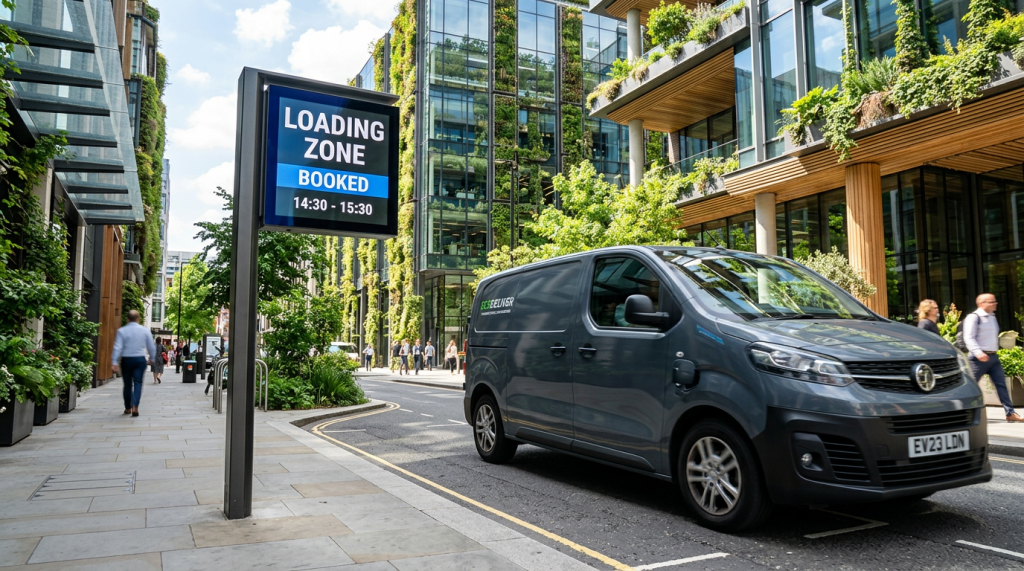
Static street signs are giving way to digital kerbside management platforms. Using IoT sensors and real-time mapping tools, cities can turn kerbside space into a dynamically allocated asset. Logistics operators can reserve loading bays in advance for precise time slots, ensuring guaranteed access, eliminating driver search time, and preventing double-parking.
City authorities are also deploying digital twins – virtual, real-time 3D models of urban transport networks. By feeding live traffic, vehicle weight, and delivery data into these digital systems, city planners can test logistics policies, optimise delivery routes, and assess how new infrastructure affects traffic flow before making changes on the ground.
Electrified urban waterways and subterranean freight
Cities with natural river networks or historic canal systems are turning to waterborne freight. Zero-emission electric barges are being used to move construction materials, waste, and parcel freight into urban centres, removing heavy trucks from congested city streets.
In addition, advanced subterranean transport systems are moving from concept to reality. Dedicated underground freight tubes – using automated, electrically powered capsules guided by linear induction motors – can transport palletised goods directly from regional sorting facilities into inner-city distribution hubs, completely bypassing surface traffic.
The road ahead: An outlook on tomorrow’s logistics
Looking toward the coming decades, the connection between urban freight and the future of cities will be defined by deep integration, clean technology, and multi-functional infrastructure design. Isolated supply chains and reactive municipal planning will be replaced by unified urban mobility frameworks.
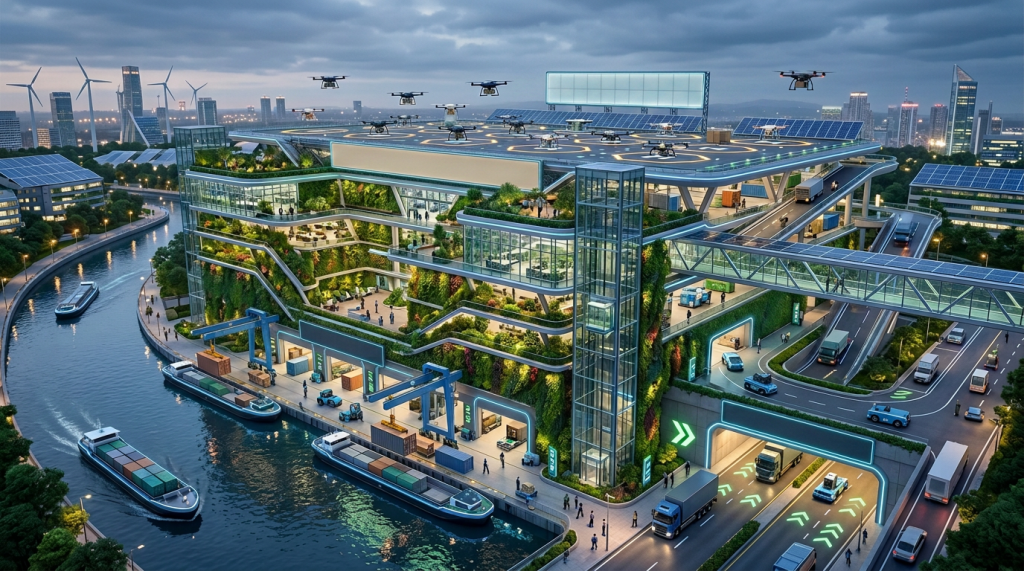
In the city of the future, logistics facilities will serve as multi-functional community assets. Rather than industrial sites tucked out of view, urban distribution centres will feature rooftop community farms, solar power plants, and public parks woven into their facades. These biophilic designs will help cool surrounding urban areas, capture carbon, and reduce rainwater runoff, turning freight hubs into positive contributors to the local environment.
Residential and commercial buildings will also adapt structurally to support modern logistics flows. New developments will feature automated parcel reception rooms, cold-storage lockers for food deliveries, and dedicated subterranean delivery docks designed specifically for electric, autonomous vehicles. High-capacity drone ports and rooftop landing pads may handle emergency medical dispatches, transporting urgent supplies between hospitals via automated sky corridors.
As artificial intelligence and automated systems mature, urban freight networks will operate with unprecedented precision. Machine learning algorithms will predict consumer purchasing trends down to the neighbourhood level, placing inventory in nearby micro-hubs before orders are even placed. Goods will move seamlessly through shared, zero-emission supply networks, operating quietly behind the scenes to keep the city running cleanly and efficiently.

Urban freight is the critical mechanism that powers the modern city, moving everything from heavy building supplies to daily e-commerce deliveries. Historically overlooked in municipal design, rising delivery volumes and logistics sprawl have made freight a top priority for urban planners.
Cities face significant operational challenges today, including kerbside competition, last-mile friction, and high road congestion. However, a wide range of technological and architectural innovations is transforming the industry. Micro-hubs, electrified fleets, solar-powered infrastructure, dynamic kerbside allocation software, and waterborne or subterranean freight systems demonstrate that logistics can operate cleanly, quietly, and efficiently within dense urban spaces.
The future of cities relies on moving away from fragmented, reactive freight management toward an integrated, tech-enabled model. By combining clean transport technologies, green infrastructure, and intelligent spatial planning, we can build efficient, resilient, and highly functional cities for the future.
Building the functional, clean-energy cities of tomorrow requires bold decisions today.
What do you think, are loading zones, micro-hubs, and clean fleet charging solutions integrated into your city?
Next week, we are investigating whether crop diversity increases urban resilience and antifragility!
Ready to build a better tomorrow for our cities? I’d love to hear your thoughts, ideas, or even explore ways we can collaborate. Connect with me at info@fannimelles.com or find me on Twitter/X at @fannimelles – let’s make urban innovation a reality together!


Leave a comment