The architecture of human settlement is undergoing a profound transformation. As global populations continue to cluster in metropolitan hubs, the sheer complexity of managing these sprawling environments has outpaced the capabilities of traditional administrative frameworks. We are standing at the precipice of a new era in city management, driven by rapid technological advancements, new jurisdictional models, and the urgent need for heightened operational efficiency.
For urban planners, technologists, and policymakers, understanding this shift is no longer optional; it is imperative. The conversation is moving rapidly from the theoretical possibilities to the concrete reality of autonomous systems, competitive governance structures, and highly participatory civic platforms. This evolution demands a fundamental rethinking of how decisions are made, how resources are allocated, and how the physical and digital realms intersect.

What urban governance means currently
At its core, urban governance refers to the complex matrix of institutions, mechanisms, and processes through which a city is administered. Currently, this model is predominantly hierarchical, centralised, and heavily reliant on slow-moving bureaucratic processes (though definitely more fast-paced than federal or national governments). It is a system built for a slower, less connected world, functioning within rigid geographic boundaries that were often drawn centuries ago.
In most global cities, decision-making is concentrated within municipal councils and specialised, often siloed, departments – transport, waste management, utilities, and urban planning. These entities typically operate independently, with distinct budgets, disparate data collection methods, and isolated strategic goals. When a city needs to address a complex issue, such as severe traffic congestion, the process usually involves commissioning lengthy consulting reports, conducting manual traffic studies, holding extensive committee hearings, and eventually rolling out a static infrastructure project years after the initial problem was identified.
Current governance is fundamentally reactive. City administrators respond to crises – a burst water main, a spike in crime, a collapsed bridge – after they occur. Data collection relies on periodic censuses, manual surveying, and lagging economic indicators. Furthermore, the legal and zoning frameworks that guide urban development are largely rigid, relying on fixed land-use designations that struggle to adapt to rapid economic or technological shifts. The traditional model prioritises stability and standardisation over agility and real-time responsiveness. While this provided necessary order during the industrial era, the sheer velocity of modern urbanisation renders these static, monopolistic models increasingly obsolete.
Micah Gaudet, a national expert on AI in local government, highlights one of the shortcomings of the current urban governance approaches, saying that they are not prepared to work with the upcoming AI and social media native generations in episode 450P of the What is The Future for Cities? podcast:
What forms urban governance can take in the future
The future of urban governance represents a paradigm shift from reactive management to proactive, anticipatory, and continuous optimisation. However, it also represents a structural shift in who and what governs. Tomorrow’s governance will not simply be about elected officials debating policy in a city hall; it will be about dynamic, data-driven ecosystems, as well as entirely new jurisdictional frameworks that challenge the traditional municipal monopoly.
We are witnessing the unbundling of the city governance. As physical location becomes less tied to economic output, cities are having to compete on the quality of their governance. This is giving rise to emerging forms of urban administration that operate more like agile technology platforms than traditional governments.
Free economic zones and regulatory sandboxes
Historically used primarily to offer tax incentives, free economic zones (FEZs) are evolving into sophisticated regulatory sandboxes. In the future, these zones will serve as the testing grounds for advanced urban governance. By carving out specific geographic areas with customised, highly permissive legal frameworks, cities can rapidly prototype autonomous vehicle networks, commercial drone delivery, algorithmic zoning, or any other innovation, like healthcare experiments, without having to overhaul the entire regulatory apparatus of the broader municipality. These zones represent a shift toward fragmented, specialised governance tailored to specific economic or technological functions.
Startup societies and charter cities
Going a step further, the concept of the startup society or charter city introduces the idea of privately managed, purpose-built urban environments. In these models, a private entity partners with a host nation to develop a new city from the ground up, complete with its own bespoke legal system, dispute resolution mechanisms, and administrative services. Operating under the premise that governance is a service to be optimised, these cities aim to attract residents and businesses by offering hyper-efficient administration, streamlined regulations, and high-quality infrastructure. This introduces market competition directly into the sphere of urban governance.
Network states
Perhaps the most radical emerging form of governance is the network state. This concept flips the traditional model of city-building on its head. Instead of acquiring land and then building a community, a network state begins as a highly aligned, cloud-first digital community. Over time, this digital society develops its own internal economy, governance protocols, and collective capital. Eventually, the community crowdfunds physical territory around the globe, creating a distributed, decentralised city connected by the internet rather than physical proximity. Governance in a network state is entirely digital, borderless, and opt-in, relying heavily on blockchain technology and smart contracts to enforce laws and distribute resources.
Dr Nathalie Mezza-Garcia, digital and water-based jurisdiction architect, described these emerging forms of urban governance in episode 432I on the What is The Future for Cities? podcast:
Emerging solutions for urban governance
To support both traditional municipalities upgrading their systems and these radical new forms of governance, a suite of advanced technological solutions is rapidly maturing. These tools are reshaping the mechanics of city management and the relationship between the governing and the governed.
Tech-enabled civic participation
One of the most transformative impacts of digitised urban governance is the radical expansion of civic participation. Historically, getting involved in city planning required attending inaccessible town hall meetings during work hours to review opaque technical documents. Today, new technologies are democratising access to information. Open data portals allow citizens to access real-time municipal datasets, from air quality metrics to municipal spending.
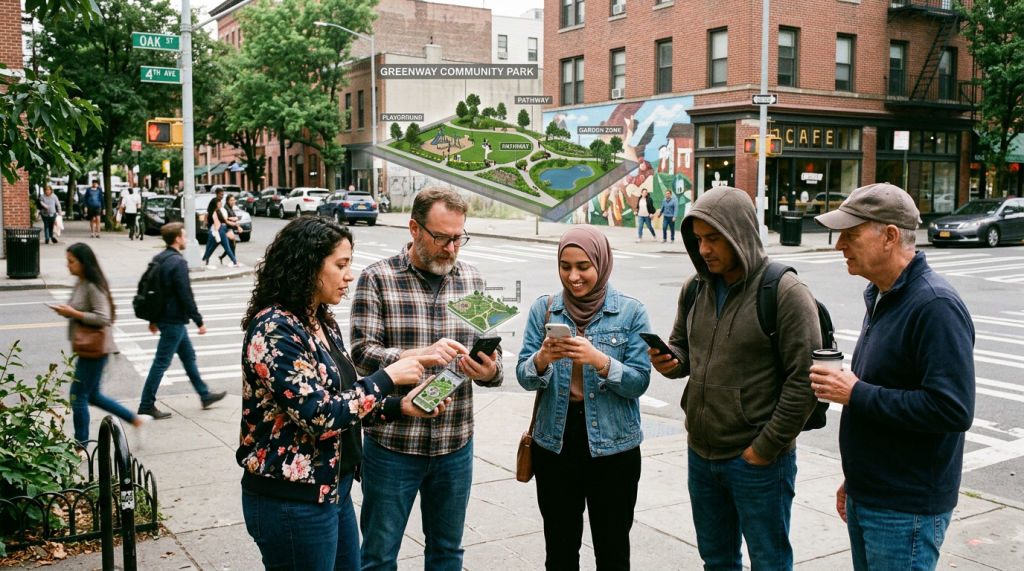
With augmented reality (AR) applications, residents can point their smartphones at an empty lot and view proposed architectural developments, providing immediate feedback via integrated mobile platforms. Blockchain technology is enabling secure, transparent participatory budgeting, allowing citizens to vote directly on how a percentage of the municipal budget is allocated without relying on bureaucratic intermediaries. Because people can now easily access, interpret, and interact with complex urban data, they are becoming active co-creators of their cities rather than passive consumers of municipal services.
Urban digital twins and city information modelling
Another powerful tool emerging in urban management is the Urban Digital Twin (UDT), often integrated with City Information Modelling (CIM). A digital twin is a dynamic, highly detailed virtual replica of a city’s physical assets, processes, and systems. By integrating geographic information systems (GIS), building information modelling (BIM), and real-time IoT data streams, city administrators can simulate the impact of policies before they are implemented.
Rather than relying on guesswork, human planners use the digital twin to run predictive scenario testing. A city council can virtually simulate the economic and traffic impacts of a new stadium, or test the structural resilience of the power grid during an extreme heatwave. The technology crunches the variables, but it is the human leadership that weighs the outcomes, balances competing interests, and makes the final, highly informed executive choice.
Decentralised autonomous urban management
The sheer volume of connected devices in urban environments generates a dense cyber-physical infrastructure that centralised servers struggle to manage efficiently. In response, decentralised governance architectures are emerging, involving the operational integration of IoT edge devices and embedded artificial intelligence.
In this model, immediate micro-decisions are inferred locally at the edge – for instance, a smart streetlight detecting a pedestrian and illuminating, or a sensor adjusting a localized water valve. This creates an auditable, fault-tolerant system where routine adjustments are executed reliably. The human benefit here is immense: city engineers are no longer bogged down by micro-managing daily operational hiccups. Instead, they utilise the macro-data generated by these decentralised networks to design better overall grids, plan long-term upgrades, and manage the broader structural health of the municipality.
Algorithmic and AI-driven service delivery
Cities are increasingly turning to algorithmic governance to handle complex logistical challenges. AI-driven predictive maintenance allows municipalities to monitor the acoustic signatures of underground water pipes to detect microscopic leaks before they rupture. In mobility, we are seeing the deployment of intelligent signal networks that adapt to traffic flows in real-time.
These solutions remove the friction of routine administrative delay. However, AI acts as an advanced triage system rather than a replacement for human workers. By highlighting exactly where a pipe is weakening or where traffic anomalies are occurring, algorithms suggest human expertise and physical resources exactly when and where they are most effective. AI filters the noise, allowing human operators to apply their judgment and experience to the most critical systemic challenges.
Advantages and disadvantages of the new frontier
As with any profound structural shift, the implementation of autonomous governance, competitive jurisdictions, and tech-driven civic participation brings a complex matrix of benefits and severe risks. Understanding these trade-offs is essential for city professionals.
The advantages
The most immediate advantage of these emerging forms and solutions is unprecedented operational efficiency combined with elevated human management. By automating routine tasks and creating bespoke regulatory frameworks, cities can drastically reduce operational costs and eliminate bureaucratic bottlenecks. Resource allocation becomes hyper-optimised; energy is routed to districts where it is currently needed, and human repair crews are dispatched before infrastructure fails.
Furthermore, predictive governance allows for enhanced physical resilience. Instead of reacting to disaster, cities can preemptively reinforce bridges and patch power grids based on algorithmic foresight. The integration of transparent blockchain ledgers significantly reduces municipal corruption and financial mismanagement, as every automated contract and data transaction is permanently recorded. Finally, the rise of tech-enabled participation ensures that city administrators are constantly supplied with accurate data, allowing human leaders to craft policies that reflect the immediate realities of their populace.
The disadvantages
However, the push towards automated, fragmented governance is fraught with complications. Technologically, the most pressing issue is the “interoperability paradox.” While internal integration within specific departments is progressing, cross-organisational connectivity remains incredibly poor. If a charter city’s transport systems cannot seamlessly communicate with the surrounding region’s emergency services due to proprietary software lock-ins, the concept of a cohesive urban network breaks down.
There is also a pronounced physical-social data divide. If civic participation relies heavily on digital apps and AR interfaces, those lacking technological literacy or device access are effectively silenced in the new governance model, leading to skewed data and biased algorithmic outcomes. Additionally, the reliance on automated governance introduces severe cybersecurity vulnerabilities. A decentralised network managing a city’s water, power, and traffic is a prime target for hostile state actors or ransomware syndicates. Finally, there is the risk of “algorithmic black boxes,” where decisions impacting daily life are made by machine learning models so complex that their developers cannot fully explain the rationale behind a specific output, severely eroding public trust.
Ana Maria Bustamante Duarte, architect and urban researcher, warned that data use itself needs to happen in a pluralistic way if we want to max out the positive outcomes in episode 450P of the What is The Future for Cities? podcast:
Outlook for the next decade
Looking ahead, the next decade of urban governance will be characterised by a period of intense experimentation and a subsequent reality check. The utopian visions of flawlessly automated smart cities and frictionless startup societies will confront the messy realities of legacy infrastructure, strict national regulations, and budget constraints. The focus will necessarily shift from the procurement of flashy hardware to the less glamorous work of data standardisation, legal framework design, and platform interoperability.
We will likely see a bifurcation in how global cities develop. Some municipalities and emerging charter cities will successfully implement robust digital public infrastructure, creating interoperable platforms that act as a secure, neutral foundation for automated services and high-volume citizen participation. These entities will reap the benefits of economic efficiency, rapid innovation, and heightened resilience. Conversely, cities that rush to purchase disconnected, proprietary technologies without a unified governance strategy will find themselves burdened with expensive, incompatible systems that fail to deliver meaningful improvements.
Ultimately, the successful future of urban governance relies heavily on elevating the role of human administrators and the citizens themselves. City leaders must become adept regulators of complex technological ecosystems, ensuring that automated systems possess rigorous human oversight, transparent algorithms, and built-in fail-safes. The technology must serve as a tool to sharpen human insight, not a shield to hide behind.
Balamurugan Soundararaj, Senior Lecturer at the City Futures Research Centre, UNSW Sydney, and CTO of MapAI, said that the shift is already happening as we have stepped into the age of building from the age of ideas in episode 450P of the What is The Future for Cities? podcast:
The discipline of urban governance is migrating from a traditional, reactive, and geographically monopolistic administrative model toward one that is highly dynamic, predictive, and competitive. Driven by emerging models like network states and startup societies, alongside technological innovations such as Urban Digital Twins, decentralised IoT networks, and AI service delivery, the cities of tomorrow promise unmatched efficiency. Crucially, these technological solutions act as cognitive enhancements for human administrators, filtering vast amounts of data to empower better, faster, and more informed executive decision-making.
Furthermore, new digital platforms are granting citizens unprecedented access to information, transforming them into active participants in the governance process. While this transition offers the ability to optimise infrastructure and lower municipal costs, it introduces significant hurdles, including severe cybersecurity risks, the fragmentation of legal jurisdictions, and the danger of algorithmic opacity. Moving forward, the true challenge for urban leaders will be the architectural design of the governance frameworks required to manage, audit, and secure these disparate innovations while keeping human judgment at the helm.
The transition to autonomous, participatory, and multi-jurisdictional urban governance is inevitable, but its success is not guaranteed. Urban professionals, city planners, and technology vendors must urgently move beyond working in isolated silos. It is critical that we begin establishing rigorous, cross-sector data standards and interoperability protocols today.
The blueprint for tomorrow’s cities is being drafted right now; it is time to take an active role in defining its parameters.

Next week, we are investigating urban logistics and its connection to urban planning!
Ready to build a better tomorrow for our cities? I’d love to hear your thoughts, ideas, or even explore ways we can collaborate. Connect with me at info@fannimelles.com or find me on Twitter/X at @fannimelles – let’s make urban innovation a reality together!


Leave a comment