
When we talk about cities, sustainability is often the first buzzword thrown into the mix, but is it enough? Is sustainability truly what we should aim for, or is there something more? As cities grow and adapt, it’s clear that many urban systems need more than just maintenance—they need to evolve and thrive under pressure. This brings us to a bigger question: Should we be thinking beyond sustainability and moving toward regeneration, which sits closer to antifragility on the scale of urban resilience?
Sustainability: Keeping the current status quo intact?
Sustainability, at its core, means meeting our current needs without compromising the ability of future generations to meet theirs—a definition that originated from the Brundtland Report in 1987:
“[Sustainable development is] meeting the needs of the present without compromising the ability of future generations to meet their own needs.”
This report laid the foundation for global thinking on sustainable development, offering an inspiring vision of balance between economic growth, environmental protection, and social equity. It inspired countless initiatives, policies, and strategies worldwide. However, despite its broad appeal, the concept of sustainability remains somewhat vague, and its application often feels murky.
Additionally, if we investigate what the word itself means – going back to the root – the implied narrative can be dangerous. Sustainability comes from the idea and the root of ‘to sustain’ – as David Deutsch in his The Beginning of Infinity book detailed. We can ‘sustain’ systems or people – both of these aspirations can be questionable. Personally, I do not want to necessarily sustain systems because we can improve them (hence conscious urban evolution and the Smarter City Flywheel), and I do not want people to be sustained – a.k.a. just allowed to be survive – because I want us to thrive.
Another problem lies in the fact that “sustainability” has been stretched to cover everything from genuine environmental practices to mere lip service, making it susceptible to greenwashing. In an era where being “green” is fashionable, companies, governments, and organizations often overstate their eco-friendly actions without delivering substantial change. This has diluted the concept, turning it from a bold, future-focused idea into something that sometimes serves as a superficial label

Many professionals now argue that sustainability, while useful as a conversation starter, may not be the ultimate goal we should pursue. Its appeal lies in its familiarity—everyone feels they have a grasp on what it means, making it an easy entry point for discussions. However, this familiarity may also be its weakness. Sustainability focuses on maintaining the status quo, but in an increasingly unpredictable world, simply sustaining isn’t enough. We need cities that can do more than survive; we need cities that can adapt, evolve, and thrive. This is where antifragility steps in—offering a framework that pushes us beyond mere endurance to embrace systems that grow stronger in the face of adversity. As cities continue to face new and unforeseen challenges, perhaps it’s time to move away from the comfort of sustainability and lean into the potential of antifragility.
Antifragility: Thriving on Shocks
While sustainability focuses on maintaining balance and enduring, antifragility goes a step further. Antifragility, as coined by Nassim Nicholas Taleb in his book Antifragile, is the ability of systems to not only survive but improve when exposed to volatility, disorder, or shocks. In simple terms, it’s about thriving under stress rather than just withstanding it. Think of it this way: a city that is merely sustainable can keep operating under normal conditions, but a city that is antifragile gets better with every challenge it faces. It learns from crises—be it natural disasters, economic shocks, or social unrest—and comes out stronger, more adaptable, and more resilient.
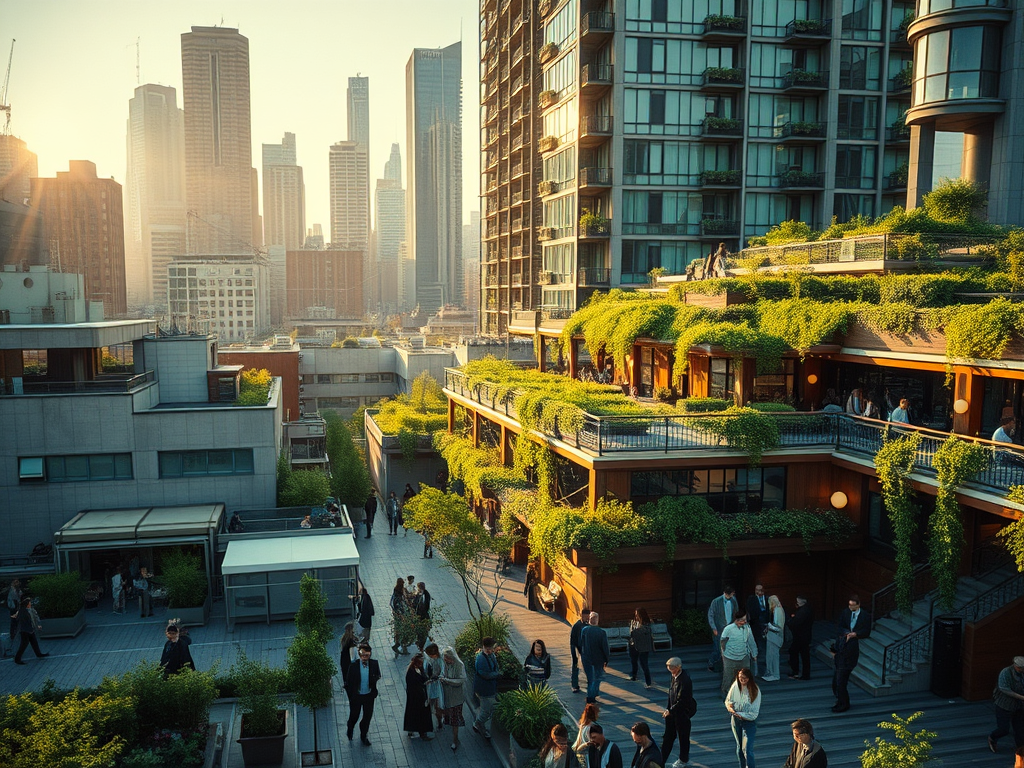
Yet, as promising as antifragility sounds, scaling this concept to the level of entire cities is difficult. Urban infrastructure is typically built for stability, not adaptability. Roads, buildings, utilities—these are not systems that can easily change course or evolve when faced with disruption. However, some smaller-scale elements within cities are already showing the potential for antifragility.
Multi-functional spaces are an excellent example of antifragility in urban design. These spaces are built with flexibility in mind, capable of shifting between different uses depending on the circumstances. Take a public square, for example. On a typical day, it might serve as a recreational area for local residents, a space for socializing, events, or markets. However, in times of crisis—whether it’s a natural disaster or a social emergency—that same space can quickly transform into an emergency shelter, a food distribution point, or even a command center for relief efforts. This adaptability allows cities to respond to both day-to-day needs and extreme events without needing to overhaul the infrastructure. By being designed to accommodate change, multi-functional spaces become stronger, more valuable assets in the face of stress, showing the potential of antifragility on a local scale.
A city’s ability to bounce back from disruption doesn’t only depend on physical infrastructure—it also relies on the strength of its social fabric. Strong community networks, where neighbors know and support each other, are a critical component of antifragility. In times of crisis, these social connections enable quick mobilization of resources and information. Whether it’s organizing to check on elderly residents during a heatwave, sharing supplies in the aftermath of a storm, or collectively addressing local issues, communities with strong networks tend to recover more quickly and effectively. These bonds aren’t just beneficial in emergencies—they build trust, resilience, and adaptability over time, making the city as a whole stronger and more prepared to face future challenges. A well-connected community doesn’t just survive; it evolves and thrives, embodying the principles of antifragility.
These are the grassroots examples of antifragility at play in urban contexts. While applying these principles to entire cities remains complex, these localised practices demonstrate that antifragility is not out of reach.
Regeneration: A Step Between Sustainability and Antifragility
If sustainability is about maintaining what we have, and antifragility is about thriving through adversity, then regeneration occupies a critical middle ground—closer to antifragility but grounded in restoration and renewal. Regeneration goes beyond merely sustaining what exists; it focuses on healing and improving systems that have been damaged or depleted, allowing them to adapt and evolve for future needs.
In an urban context, regeneration involves revitalising not only the built environment but also the natural and social systems that cities rely on (regeneration is the focus of the discussion in episode 266 with Alison Whitten from Regen Melbourne on the What is The Future for Cities? podcast). It aims to enhance biodiversity, repair ecosystems, and restore community health, making cities stronger, more adaptable, and more attuned to the environment. Importantly, regeneration doesn’t just replace what’s been lost—it creates opportunities for new growth and innovation. In this way, it builds toward antifragility, enabling cities to thrive through renewal and transformation.
But regeneration also requires a selective approach. Not everything within a city needs to be regenerated. Instead, we must carefully consider what aspects of urban life require renewal and what should be left to evolve on their own. More importantly, regeneration should not hinder human progress. We cannot let the desire to regenerate distract from necessary development and innovation. There needs to be a balance—an understanding of where regeneration will be most impactful and where efforts can be directed toward future growth.
For example, redeveloping an abandoned industrial zone into a mixed-use urban area might be a prime case for regeneration, as it revitalises a decaying part of the city while creating new opportunities for its residents. On the other hand, regenerating a functional neighborhood for the sake of “greening” could risk wasting resources that could be better spent on forward-looking projects.
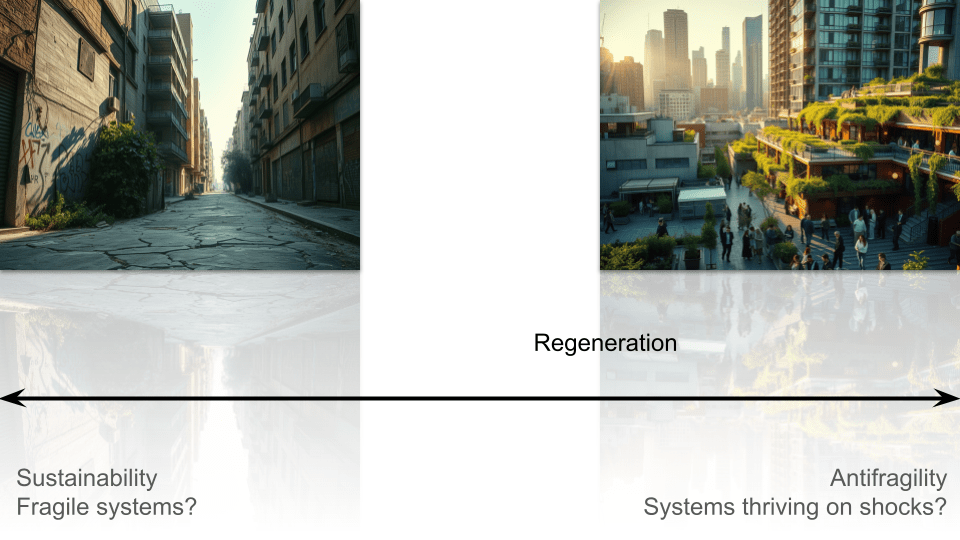
How to best prepare for the uncertainty of the future?
So, where does this leave us? Sustainability is still essential but may no longer be enough for our rapidly changing world. As we look toward a future that will undoubtedly bring more shocks and stresses, it’s time to explore how we can integrate antifragile principles and embrace regeneration as a critical step in this journey. Cities that can not only survive but adapt, renew, and thrive will be the ones that shape our future.
What battles should we pick in our pursuit of sustainable urban development? How can cities realistically embrace antifragility while carefully choosing where regeneration efforts are most needed? And most importantly, how do we balance regeneration with the need for progress and innovation? Let’s continue this conversation and shape the future of our cities together.
 Vitruvian Solutions
Leave a reply to Cities through time: A journey to tomorrow’s urban horizons – Vitruvian Solutions Cancel reply