Is energy the true foundation of cities that not only survive but grow stronger through disruption?
Picture a modern metropolis at peak hour: trains halted, hospitals running on backup generators that may or may not last, data centres dark, supply chains frozen, and millions of people suddenly unable to work, communicate or even access clean water. A single widespread power failure does not just inconvenience; it exposes how every layer of urban life rests on one invisible pillar – abundant, reliable energy. In an era of intensifying volatility, from extreme weather to geopolitical shocks and technological leaps, the question is no longer whether cities can endure. It is whether their energy foundations allow them to emerge tougher, smarter and more capable than before.
This is not about predicting every crisis. It is about recognising that energy systems determine whether a city merely bounces back or actually benefits from stress. Resilience is the capacity to absorb shocks and return to function. Antifragility, the concept popularised by Nassim Nicholas Taleb, goes further: systems that gain strength, adaptability and performance from volatility, randomness and disorder. Energy sits at the core of both. Without it, even the most sophisticated urban designs collapse. With thoughtfully engineered abundance, diversity and decentralisation, cities can turn blackouts, demand spikes and supply interruptions into opportunities for improvement.
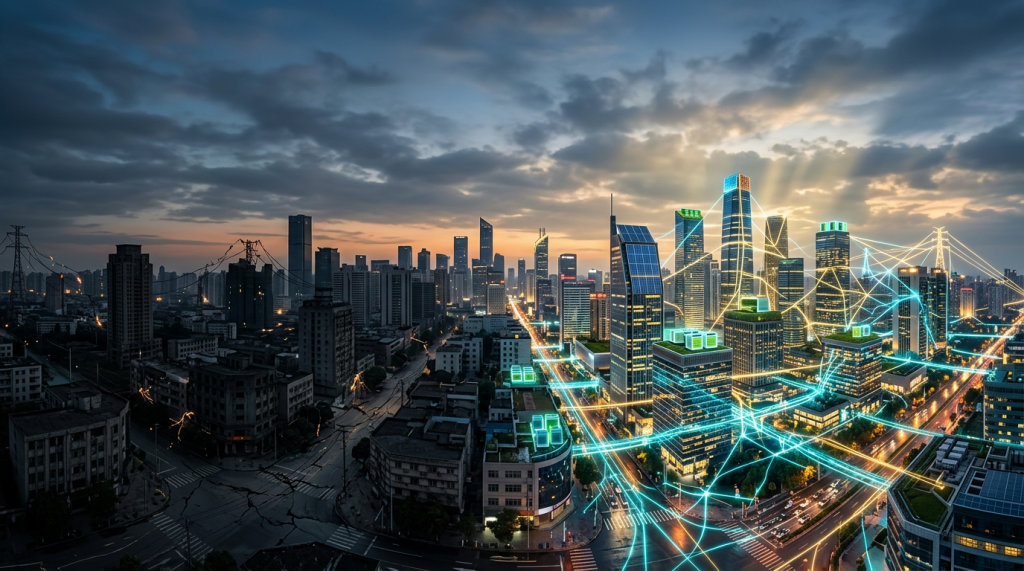
Energy: the non-negotiable foundation of modern urban life
Every critical urban function traces back to energy. Water treatment and distribution, telecommunications, transport networks, healthcare, emergency services, manufacturing and the explosive growth of data-intensive industries all depend on continuous power. Global cities already consume around 75 per cent of the world’s energy, a share that continues to rise with digitalisation and the proliferation of energy-hungry technologies. When that foundation wavers, the entire edifice trembles.
Consider what happens during even brief outages. Research analysing a nationwide blackout in Chile in February 2025 – which left more than 90 per cent of the population without electricity for several hours – revealed stark economic consequences. Economic transactions dropped roughly 35 per cent on the day itself. Immediate losses reached approximately $70 million, or $2,170 per megawatt-hour of electricity lost. After accounting for postponed spending in the following days, the net figure was still $36 million. Sectors dealing in perishable or time-sensitive goods suffered more persistent damage, while durable-goods sales largely recovered. These are not abstract numbers; they represent stalled innovation, lost productivity and real constraints on urban dynamism.
Reliable energy is therefore not a luxury. It is the precondition for any city to maintain its core operations under stress and to pursue the experimentation that drives progress.
Episode 425R on the What is The Future for Cities? podcast discusses the energy as a foundation:
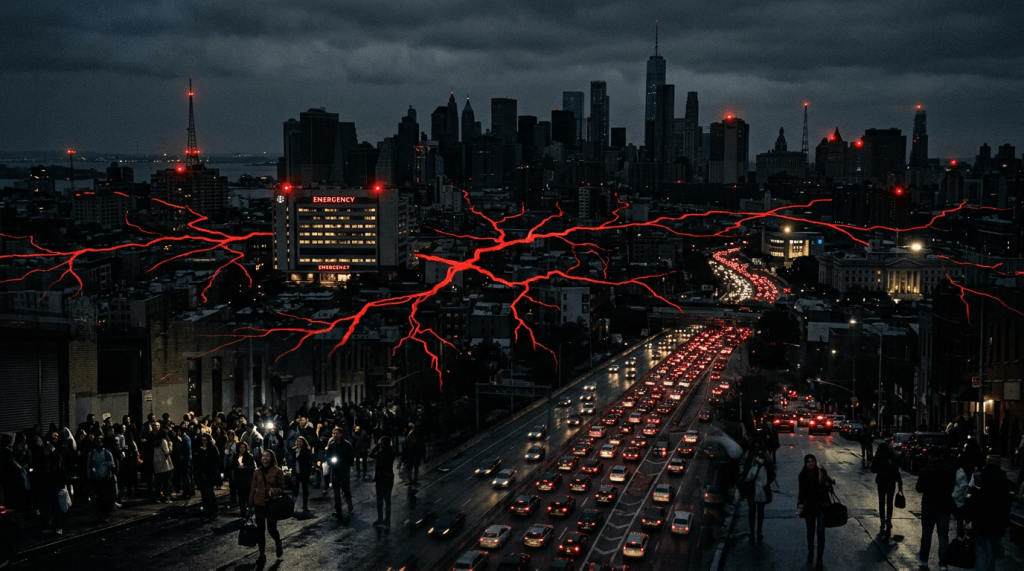
Blackouts expose the fragility we can no longer afford
Centralised, brittle grids remain the default in many places. A single point of failure – a transmission line damaged by storms, a substation overwhelmed by demand, or a fuel-supply interruption – can cascade into city-wide paralysis. The economic literature consistently shows that longer outages inflict disproportionate costs, and that commercial and industrial users bear the heaviest burden. In the United States alone, power disruptions are estimated to cost businesses well over $100 billion annually when indirect effects are included.
Fragile systems punish unpredictability. They are optimised for calm conditions and break when volatility arrives. Cities that treat energy as an afterthought or a purely technical utility find themselves repeatedly rebuilding the same vulnerabilities after each shock. The lesson from repeated blackouts worldwide is clear: fragility is expensive, and it compounds over time.
Redundancy, diversity and decentralisation: the architecture of resilience
True resilience begins with deliberate redundancy. Multiple pathways for power delivery, backup generation at critical sites, and the ability to isolate faults before they spread all reduce the impact of any single failure. Diversity of sources and technologies further strengthens the system; no single fuel or technology dominates to the point of systemic risk.
Decentralisation takes this further. Microgrids – localised energy systems that can operate independently or in parallel with the main grid – have demonstrated their value repeatedly. During Hurricane Sandy, microgrids kept critical facilities such as hospitals and emergency centres running while surrounding areas went dark. In Brooklyn, New York, a pioneering microgrid project enables peer-to-peer energy trading among residents and businesses, creating local autonomy and rapid response capability. In Portland, Oregon, a five-storey “Living Building” integrates on-site solar and battery storage, providing both everyday power and seismic resilience rated to Category 4 earthquake standards.
These examples illustrate how decentralised architectures create optionality. When the main grid falters, local systems continue. When conditions stabilise, they can export surplus or recharge. This is not merely backup; it is structural flexibility that prevents total collapse.

From resilience to antifragility: energy systems that improve under stress
Resilience keeps the lights on. Antifragility uses the stress itself to become better. Decentralised energy systems excel here because they turn volatility into information and opportunity.
Local microgrids and distributed generation allow rapid trial and error at neighbourhood scale. A failed pilot project affects only a small area and yields immediate lessons that can be applied elsewhere. Successful configurations – better storage pairings, smarter demand response, innovative trading protocols – spread quickly without requiring city-wide consensus or massive capital outlays. Volatility in supply or demand becomes a forcing function for innovation rather than a threat.
Cities that embrace this approach develop “optionality”: multiple small bets instead of one giant, fragile commitment. They can scale what works and discard what does not. Over repeated cycles of stress, the urban energy fabric strengthens, becoming more adaptive, more efficient under pressure, and more capable of supporting ever-higher levels of complexity and activity.
Palo Alto in California offers a compelling municipal example. As one of the few US cities that owns its full utility system, it has invested in advanced sensors, undergrounding of infrastructure and a new transmission line specifically to maintain reliability against wildfires and supply-chain disruptions. These upgrades were not reactive patches; they were proactive strengthening that positions the city to handle greater volatility ahead. Similar logic appears in Tokyo’s long-standing emphasis on grid hardening and preparedness, which consistently ranks the city among the world’s most resilient.
AJ Perkins highlighted distributed energy systems as one of the biggest opportunities for the future of cities – besides using islands like Hawaii as living labs – in episode 426I on the What is The Future for Cities? podcast:
The path forward: prioritising energy as the bedrock of antifragile urban futures
The cities that will define the coming decades are those that treat energy infrastructure with the same strategic seriousness once reserved for defence or transport. This means:
- Investing in grid modernisation that prioritises redundancy and rapid fault isolation.
- Accelerating deployment of microgrids and distributed resources around critical nodes and innovation districts.
- Fostering regulatory environments that reward local generation, storage and flexible demand rather than locking in rigid centralised models.
- Building institutional capacity to learn quickly from every disruption and feed those lessons back into system design.

Abundant, reliable and adaptable energy does more than prevent failure. It creates the headroom for cities to experiment with new mobility systems, advanced manufacturing, artificial-intelligence infrastructure and dense, high-value economic activity – all of which increase the stakes if power becomes unreliable.
In a world of accelerating change, the cities that thrive will not be those that merely withstand the next shock. They will be those whose energy foundations turn every challenge into a catalyst for greater capability. Energy is not one input among many. It is the foundation upon which better, stronger urban futures are built.
The question is no longer whether we can afford to prioritise it. It is whether we can afford not to. Cities that get this right will not just endure the turbulence ahead – they will be forged stronger by it.

Next week, we are investigating amphibious architecture!
Ready to build a better tomorrow for our cities? I’d love to hear your thoughts, ideas, or even explore ways we can collaborate. Connect with me at info@fannimelles.com or find me on Twitter/X at @fannimelles – let’s make urban innovation a reality together!
 Vitruvian Solutions
Leave a comment