If we look back at how cities have evolved over the past century, a clear pattern emerges. In many Western nations, particularly in North America and Australia, the post-WWII era was defined by the pursuit of suburban sprawl. The dream of a detached home on a large block of land necessitated the construction of extensive motorway networks, often sacrificing dense, human-scale neighbourhoods for driving convenience. However, as global populations have surged and urbanised at unprecedented rates, this car-centric model has reached its physical and economic breaking point, revealing a deeply fragile system.
Traffic congestion is more than just a daily nuisance; it is an economic crisis that restricts individual freedom and chokes productivity. According to the INRIX 2024 Global Traffic Scorecard, drivers in heavily congested cities such as New York and Chicago lost over 100 hours a year to traffic jams. In the United States alone, this delay cost the economy an estimated $74 billion in lost time and productivity in 2024. Building our way out of congestion by adding more lanes is a mathematical impossibility due to the phenomenon of ‘induced demand’ – where increasing road capacity simply encourages more people to drive, quickly filling the new space. To move forward and build robust, dynamic urban centres, we must pivot away from a monolithic reliance on private cars and embrace a diverse, integrated transport ecosystem.
Defining multimodal transportation and micromobility
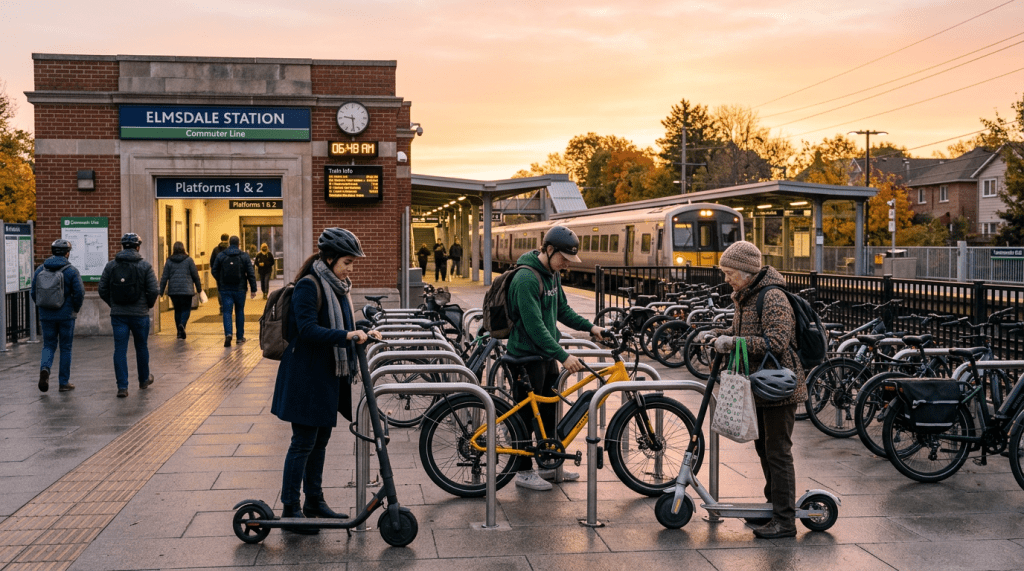
To properly understand the future of urban mobility, we must break down two fundamental concepts: multimodal transport and micromobility. Multimodal transportation refers to a network where travellers can seamlessly combine two or more modes of transport within a single journey. Rather than driving a personal car from origin to destination, a multimodal commuter might ride a bicycle to a regional train station, catch a fast commuter train into the central business district, and then walk the remaining distance to their office.
Micromobility, on the other hand, describes a growing category of small, lightweight vehicles operating at speeds typically below 25 kilometres per hour and driven by users personally. This encompasses traditional bicycles, e-bikes, e-scooters, and electric skateboards. Over the past decade, shared micromobility schemes have exploded in popularity globally, dotting city streets with dockless scooters and rental bikes. Furthermore, the rise of electric cargo bikes is revolutionising urban logistics, proving that even heavy goods delivery and the daily school run can be accomplished without a two-tonne sport utility vehicle (SUV). Individually, public transit and micromobility are powerful tools. Together, they create a paradigm shift, turning fixed transit routes into dynamic, highly accessible webs that cover entire metropolitan areas.
Oliver Stoltz, a strategic transport planner, talked about improving transportation systems and urban mobility, which often includes considerations of multimodal approaches to support active and public transport in episode 194 on the What is The Future for Cities? Podcast:
Solving the first and last kilometre problem
One of the most persistent hurdles in urban transit planning is the ‘first and last kilometre’ problem. This concept refers to the beginning or end of an individual’s journey – the distance between their home or workplace and the nearest public transport hub. If a train station is a brisk 30-minute walk away, many commuters will inevitably choose the convenience of driving their private car for the entire journey instead, locking themselves into the traffic grid.
Micromobility is uniquely positioned to bridge this spatial gap. An e-scooter or e-bike turns a daunting 30-minute walk into a quick, sweat-free five-minute ride. By effectively extending the catchment area of a train station or bus interchange, micromobility significantly boosts the utility and appeal of public transport. It transforms public transit from a rigid, point-to-point service into a flexible, door-to-door solution that empowers the individual to move on their own schedule.
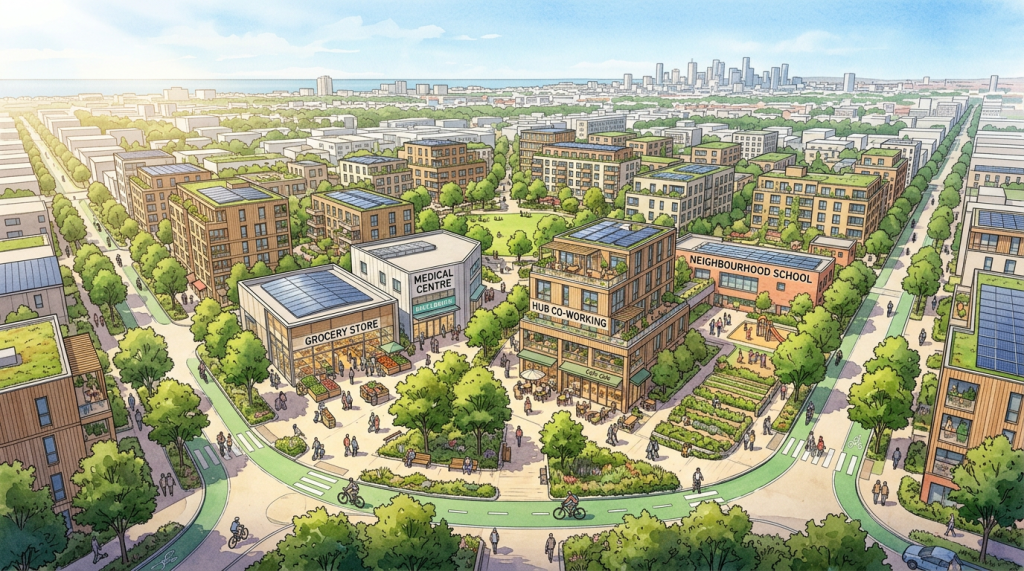
This synergy is a cornerstone of the ’15-minute city’. Conceptualised by Professor Carlos Moreno of the Sorbonne University in Paris, the 15-minute city is a globally recognised urban model designed so that residents can access all their essential daily needs – housing, work, food, healthcare, education, and leisure – within a 15-minute walk or bike ride. Professor Moreno’s research emphasises that proximity and active transport are key to decentralising cities, reducing our vulnerability to external supply shocks, and elevating the overall quality of life by giving people their time back.
There have been other researchers and experts who have been talking about the 15-minute city idea, as Boyd Cohen, the Academic Director of Sustainability at EGADE Business School of Tec de Monterrey, expressed in episode 246 on the What is The Future for Cities? Podcast:
Reclaiming our kerbsides and public spaces
When we shift our municipal focus from moving cars to moving people, the physical geometry of the city changes dramatically. Private cars are notoriously space-inefficient. A single passenger car requires a significant amount of space to operate safely at speed, and crucially, cars sit parked and completely idle for roughly 95% of their operational lives. This systemic inefficiency requires cities to dedicate vast swathes of valuable land to kerbside parking and multi-level parking complexes, stunting urban development and limiting how space can be utilised.
In stark contrast, multimodal transport and micromobility demand a fraction of this space. A single traffic lane that can move 1,000 cars per hour can comfortably move upwards of 7,000 bicycles or e-scooters in the same timeframe. By encouraging this modal shift, cities can begin the vital work of reclaiming urban space.
We are already seeing this transformation occur on a global scale. In Paris, thousands of kerbside parking spaces have been systematically removed to make way for a sprawling, interconnected network of protected cycleways. In Barcelona, the ‘Superblock’ model restricts through-traffic in residential grids, turning intersections into public plazas, community gardens, and open-air markets. As micromobility normalises, the rationale for dedicating prime city real estate to dormant metal boxes weakens. Replacing asphalt with mixed-use spaces opens up unprecedented opportunities for commercial growth, community building, and allowing neighbourhoods to organically evolve to meet the desires of their residents.
Episode 423R on the What is The Future for Cities? Podcast explores Barcelona’s Superblock model more in detail:
Mobility as a service and the digital glue
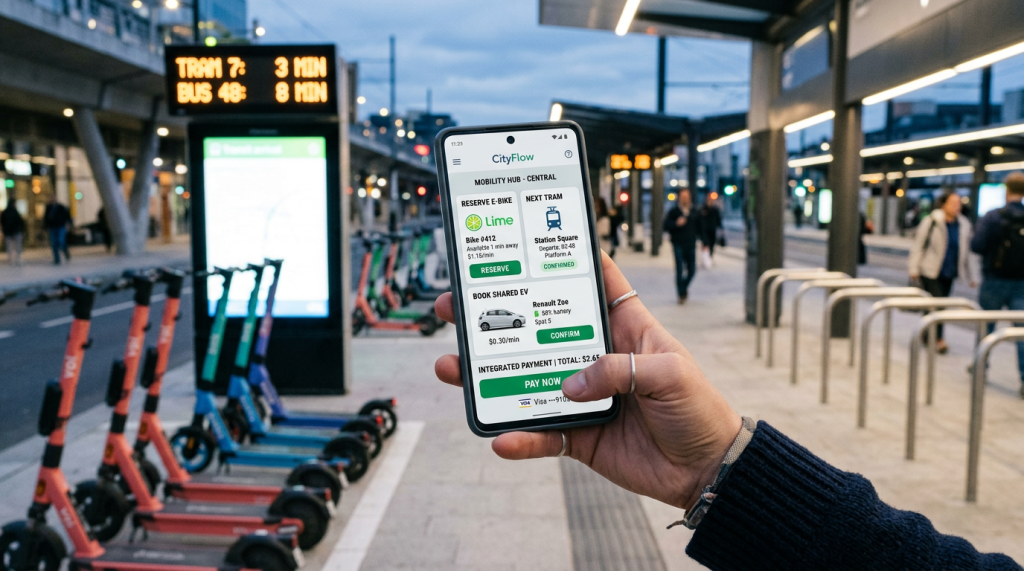
While physical infrastructure is undeniably crucial, the true enabler of multimodal transport is digital technology. The concept of Mobility as a Service (MaaS) represents the digital integration of various forms of transport into a single, user-centric interface. Imagine a scenario where your smartphone not only tells you the fastest route to work but automatically unlocks an e-bike at your front door, pays for your train fare, and reserves a shared car for your weekend getaway – all under one unified platform. This removes friction and maximises individual convenience.
Helsinki, Finland, stands as a global pioneer in this space with the introduction of the Whim app by MaaS Global. Whim functions as a digital clearinghouse, combining public transport, city bikes, e-scooters, taxis, and rental cars into a single subscription or pay-as-you-go service. The behavioural impacts of this seamless digital integration are profound. According to an Econsult Solutions case study on the Whim app, Whim users rely on public transportation for an impressive 73% of their trips, compared to just 48% for the average Helsinki resident. Furthermore, Whim users are significantly more likely to utilise multiple modes of transport for a single journey, proving that when the friction of planning, routing, and payment is removed, commuters readily embrace the freedom of multimodal travel.
Building antifragility into the urban fabric
Perhaps the most compelling argument for diversifying our transport networks is the urgent need for systemic resilience, or what author Nassim Nicholas Taleb terms ‘antifragility’. An antifragile system is one that does not merely withstand shocks but actually benefits and grows stronger from them. Our current car-dependent cities are highly fragile. A single traffic accident on a major arterial road can paralyse an entire metropolitan grid for hours. Global supply chain disruptions or sudden spikes in fuel prices can instantly cripple the economy and heavily restrict the average citizen’s ability to move freely.
A multimodal network, bolstered by robust micromobility options, introduces essential redundancy into the urban system. If a train line goes down for maintenance, a commuter can seamlessly switch to an e-bike or a bus. If a major intersection is blocked, a cyclist can easily reroute through a series of laneways or local streets. By offering multiple, overlapping paths and methods of travel, cities become highly resilient to isolated failures. The system keeps moving, adapting instantly to stress rather than collapsing under it.
There is also a powerful economic argument for this transition to resilience. Road maintenance for heavy passenger vehicles is an enormous burden on municipal budgets. A heavy car or SUV degrades road surfaces exponentially faster than a bicycle or an e-scooter. Shifting trips to lighter modes saves cities millions in infrastructure repair costs. This economic efficiency means local governments can keep taxes lower or reinvest those funds into better services, creating a more robust local economy that is less vulnerable to budgetary shortfalls.
Expanding individual opportunity and choice
Integrating micromobility into the multimodal fabric of our cities is ultimately about expanding human potential and ensuring that everyone has the opportunity to live their lives however they choose. A monolithic transport system that effectively forces citizens to own a private car to participate in society is a restrictive one. Car ownership is a massive financial burden, encompassing vehicle registration, insurance, fuel, and maintenance. When people are not shackled to these forced expenses, they have more resources to invest in their own education, businesses, or leisure.
True opportunity means having the agency to move freely. Reliable access to diverse transit options ensures that transport ‘deserts’ do not dictate a person’s prospects. If a young adult wants to accept a job on the other side of the city, or a family wants to easily access better educational facilities, a highly connected, multimodal network makes that possible without the prerequisite of owning a vehicle. It removes artificial barriers to success and empowers individuals to pursue their goals and structure their lives on their own terms.
To fully realise this vision, urban planners must navigate distinct infrastructure challenges to maximise choice and usability. Safety is paramount; individuals cannot truly exercise their freedom to use micromobility if they are forced to share space with fast-moving, heavy motor vehicles. Cities must commit to retrofitting their streets with separated, kerb-protected cycleways so that anyone – from a teenager to a retiree – has the genuine option to ride safely. Furthermore, the rapid deployment of shared dockless e-scooters requires smart management. Poorly parked scooters blocking footpaths impede the freedom of movement for pedestrians and those using mobility aids. Effective geofencing and designated parking corrals ensure that the expansion of one person’s travel choices does not infringe upon another’s right to access the city safely.
Ben Wolf, director of the Changing Lanes documentary about a New York street fighting and changing its use to be more public and car space, discussed why reclaiming streets as public space is crucial for cities in episode 424I on the What is The Future for Cities? Podcast:
The connection between multimodal transport, micromobility, and the future of our cities is inextricable. We are currently standing at a pivotal crossroads in urban design. For decades, we engineered our physical environments to accommodate the dimensions, speeds, and storage requirements of the private automobile, frequently at the expense of community vitality, economic efficiency, and individual choice.
Embracing a multimodal future requires considerably more than just deploying a fleet of brightly coloured e-scooters or launching a new transit smartphone app; it demands a fundamental shift in our civic values. It requires us to acknowledge that the true measure of a successful transport network is not how many cars it can rush through a concrete intersection, but how robust it is against disruption, and how seamlessly it can empower individuals to move to the places that matter to them.
The transition demands innovation, investment, and a willingness to rethink the status quo. But the blueprint is already being written in cities from Helsinki to Paris, and from Bogotá to Melbourne. By championing micromobility as the essential first and last kilometre link, by integrating our transit systems through smart digital platforms, and by bravely reallocating road space to diverse transport methods, we can build antifragile systems.
The cities of tomorrow will be defined by their flexibility, their resilience, and their ability to provide every individual with the freedom and opportunity to navigate the world exactly as they see fit.
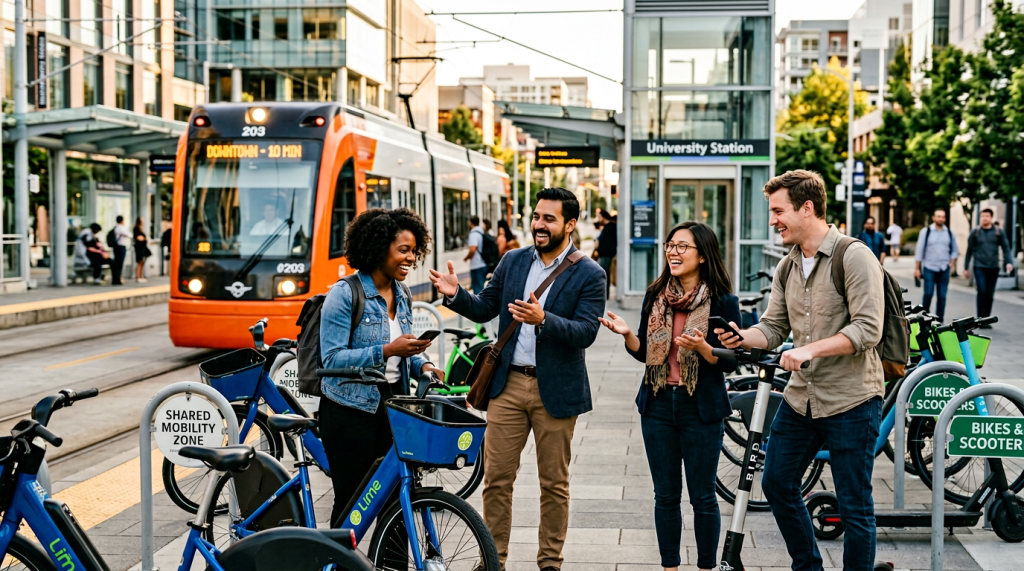
Next week, we are investigating the role of multimodel mobility for the future of cities!
Ready to build a better tomorrow for our cities? I’d love to hear your thoughts, ideas, or even explore ways we can collaborate. Connect with me at info@fannimelles.com or find me on Twitter/X at @fannimelles – let’s make urban innovation a reality together!


Leave a comment