The world is undergoing a profound demographic shift, moving away from rural landscapes and increasingly consolidating into concrete jungles. Historically, humans were scattered across the globe in small, agrarian communities, but the Industrial Revolution flipped the script. Today, we are living through the greatest mass migration in human history – the migration to the city. According to the United Nations, 55 percent of the global population currently resides in urban areas, a figure that is projected to surge to 68 percent by 2050. This means we are staring down the barrel of a future where an additional 2.5 billion people will need to be accommodated in our urban centres over the next few decades.
But what happens when a city grows? Does it simply become a larger version of its former self, or does its very nature fundamentally change? For a long time, urban planners and policymakers treated city growth as a linear progression. If a city doubled its population, it was assumed it would need exactly double the roads, double the hospitals, and double the resources, while producing double the economic output. However, modern science has revealed that cities do not grow linearly. They scale in highly predictable, mathematical ways that resemble biological organisms. Understanding how this “scaling” works is not just an interesting academic exercise; it is the master key to unlocking the future of our urban existence, dictating everything from our wealth and innovation to our exposure to crime and disease.

The mathematics of the metropolis
To understand the future of cities, we must first dive into the concept of urban scaling laws. This field of study was pioneered by theoretical physicist Geoffrey West and his team at the Santa Fe Institute. West, who originally spent his career studying the metabolic rates of mammals, began to wonder if the same mathematical principles that govern biological life could be applied to human-made networks like cities.
In biology, there is a concept known as Kleiber’s Law, which demonstrates that as animals get larger, their metabolism slows down. An elephant is massively larger than a mouse, but it uses energy far more efficiently on a per-cell basis. West discovered that cities operate on remarkably similar network principles. They are complex systems defined by their physical infrastructure networks (the roads, pipes, and cables that transport energy and resources) and their socioeconomic networks (the interactions between people).
When West and his researchers analysed data from cities all over the world – from Tokyo to New York, and from Lisbon to Sydney – they found astonishingly consistent mathematical patterns. Regardless of a city’s geography, history, or culture, its socioeconomic and physical characteristics scale with its population size in a highly predictable manner. This scaling is broken down into two distinct categories: superlinear scaling and sublinear scaling. The delicate balance between these two forces will determine whether the cities of the future will be utopian hubs of progress or dystopian landscapes of inequality and environmental collapse.

The 15 percent bonus of superlinear scaling
When it comes to human interaction and the products of our social networks, cities exhibit what is known as “superlinear scaling”. In simple terms, this means that the socioeconomic outputs of a city grow exponentially faster than its population. West’s research revealed a magical, universal metric: the 15 percent rule. Whenever a city’s population doubles, its socioeconomic metrics do not just double (which would be a linear 100 percent increase); they increase by approximately 115 percent. This applies on a per capita basis. Therefore, in a city that is twice the size of another, the average resident will earn 15 percent more income, produce 15 percent more patents, and generate 15 percent more overall wealth.
This is the gravitational pull of the modern city. It is the reason why millions of people continue to pack up their lives and move to crowded, expensive urban centres. The density of a city acts as a massive social collider. By packing people closer together, we increase the probability of interactions, the exchange of ideas, and the formation of complex professional networks. This agglomeration effect is the absolute engine of human innovation. As we look to the future, this superlinear scaling suggests that our megacities will continue to be the undisputed drivers of global economic growth and technological advancement. If we want to solve massive, existential problems like climate change or space exploration, the solutions will almost certainly be born out of the hyper-productive friction of massive cities.
This scaling is discussed in episode 421R on the What is The Future for Cities? podcast, debating The origins of scaling in cities article by Luís Bettencourt:
The dark side of exponential growth
However, the 15 percent rule is a double-edged sword. Superlinear scaling does not discriminate between the good aspects of human society and the bad. The exact same mathematics that drive wealth and innovation also drive the less desirable elements of urban living.
When a city doubles in size, it does not just experience a 15 percent per capita increase in wealth; it also experiences a 15 percent per capita increase in violent crime, traffic congestion, pollution, and the spread of infectious diseases. The social collider that sparks a brilliant new tech startup is the exact same mechanism that allows a flu virus to spread exponentially faster through a crowded train network, or facilitates the rapid organisation of criminal syndicates.
Furthermore, superlinear scaling dictates the pace of urban life. As cities grow, the actual speed at which life is lived accelerates. People literally walk faster in larger cities, transactions occur more rapidly, and the turnover of businesses is higher. This leads to a phenomenon known as the “treadmill effect”. To avoid systemic collapse brought on by rapid growth and resource depletion, cities are forced to innovate at an ever-accelerating rate. We must constantly invent our way out of the crises created by our own growth. As we move towards a future of megacities housing tens of millions of people, managing this dark side of superlinear scaling – mitigating crime, preventing pandemics, and managing the psychological toll of hyper-accelerated living – will be the greatest challenge for urban planners.
Greg Lindsay talked about both the positive and negative sides of the scaling of cities but highlighted that human capital is key for cities in episode 422I of the What is The Future for Cities? podcast:
Doing more with less through sublinear scaling
Fortunately, cities are not solely defined by the frantic pace of their social networks. They are physically grounded by their infrastructure, which operates under a completely different mathematical rule known as “sublinear scaling”.
Just as an elephant is more energy-efficient than a mouse, a large city is more infrastructure-efficient than a small town. West’s team found that when a city doubles in size, it does not need twice as many roads, twice as many petrol stations, or twice as much electrical wiring. Instead, it only needs about 85 percent more. This translates to an automatic 15 percent savings in physical infrastructure with every doubling of the population.
This sublinear scaling is an incredible economy of scale. It proves that dense urban living is inherently greener and more resource-efficient than sprawling suburban or rural living. A resident in a high-density apartment block in the centre of the city requires significantly fewer kilometres of water pipes, power lines, and paved roads to support their daily routine than someone living on a quarter-acre block in the outer suburbs. For the future of cities, leveraging this sublinear scaling is absolutely critical to achieving environmental sustainability. If we can concentrate our growing populations into dense, well-connected urban cores, we can drastically reduce our per capita carbon footprint and our consumption of raw materials.
The missing middle and the 20-minute neighbourhood
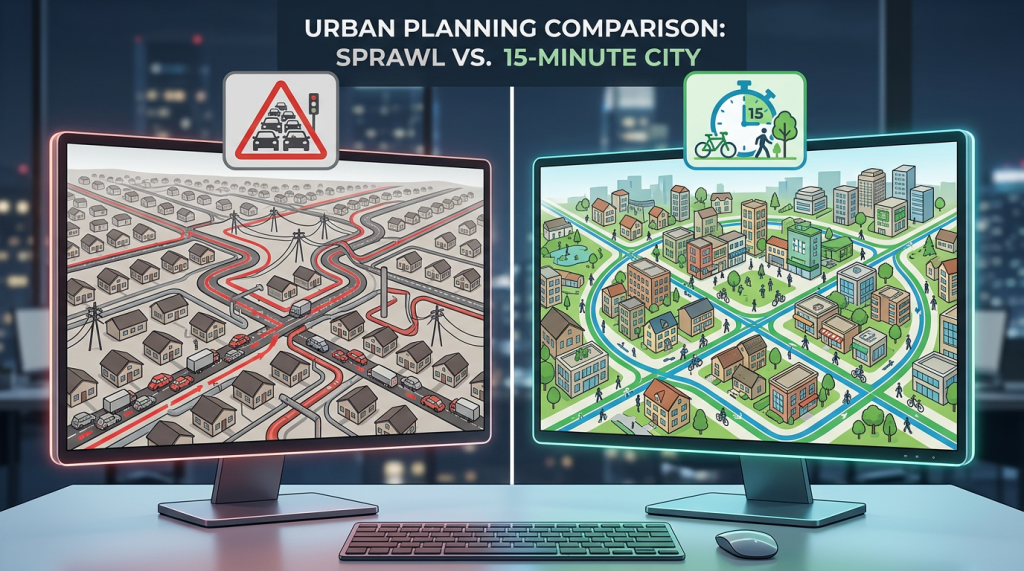
Globally, urban planners are desperately trying to correct the trajectory of unstructured growth. In many parts of the world, particularly across North America and within rapidly expanding emerging economies, urban development has become severely polarised. We often see towering, high-density skyscrapers concentrated in commercial centres, surrounded by vast, low-density suburban sprawl. This sprawling model actively undermines the 15 percent infrastructure discount of sublinear scaling. Extending water mains, roads, and public transport networks to distant fringes costs municipalities exponentially more per capita than supporting residents in more compact areas. Furthermore, sprawl diffuses the social density required for the 15 percent innovation bonus. It is incredibly difficult to have serendipitous, wealth-generating interactions when citizens are isolated in cars, travelling for two hours a day on congested motorways.
To ensure global cities have a prosperous future, the solution is increasingly framed around the concept of the “missing middle”—medium-density housing, such as townhouses, terraced homes, and low-rise apartment buildings, integrated seamlessly into existing neighbourhoods. By bridging the gap between detached single-family homes and massive high-rise towers, cities can increase population density steadily, allowing them to finally reap the full rewards of urban scaling without destroying the character of local communities.
This approach is the foundational philosophy behind the “15-minute city”, an urban planning concept championed by global metropolises like Paris. The programme is designed to ensure that most residents can access their essential everyday needs—groceries, schools, healthcare, and parks—within a 15-minute walk or bicycle ride from their front door. By creating hyper-localised, compact hubs of activity within the broader metropolis, planners are artificially engineering the social friction required for superlinear scaling (wealth and innovation) while simultaneously capitalising on the infrastructure efficiencies of sublinear scaling.
If the world’s growing cities continue to default to endless urban sprawl, they will face a future of crippling infrastructure debt, brutal traffic congestion, and a sluggish innovation sector. But if planners globally can embrace targeted density and respect the mathematical realities of city scaling, urban centres everywhere can become highly liveable powerhouses of efficiency and prosperity.
Boyd Cohen, Academic Director of EADE Business School, talked about the benefits of the 15-minute city in episode 246I on the What is The Future for Cities? podcast:
Future-proofing through city interventions
So, if the laws of urban scaling are essentially biological mandates, are we destined to just sit back and let the mathematics strictly dictate our future? Not necessarily. While the 15 percent rule provides a baseline expectation for how a city will behave as it naturally grows, urban innovation is about actively intervening in these equations.
Technology offers us a way to hack the scaling laws. For example, the superlinear increase in crime and traffic congestion can theoretically be flattened using artificial intelligence and big data analytics. Predictive policing algorithms and advanced urban monitoring aim to allocate emergency resources more efficiently to prevent crime before it escalates. Similarly, smart traffic grids, the integration of autonomous vehicles, and real-time public transport modelling can optimise the flow of movement, allowing a city to achieve the density required for high innovation without the corresponding gridlock.
Furthermore, we are learning to decouple economic growth from carbon emissions. Historically, the superlinear generation of wealth was inextricably linked to higher per capita pollution and resource waste. However, the transition to renewable energy grids, the mass electrification of transport, and the implementation of circular economy principles in urban waste management are allowing modern cities to break this historic correlation. The urban centres that will thrive in 2050 and beyond are the ones that use technology not just as a consumer novelty, but as a deliberate, structural tool to amplify the positive scaling effects while aggressively suppressing the negative ones.
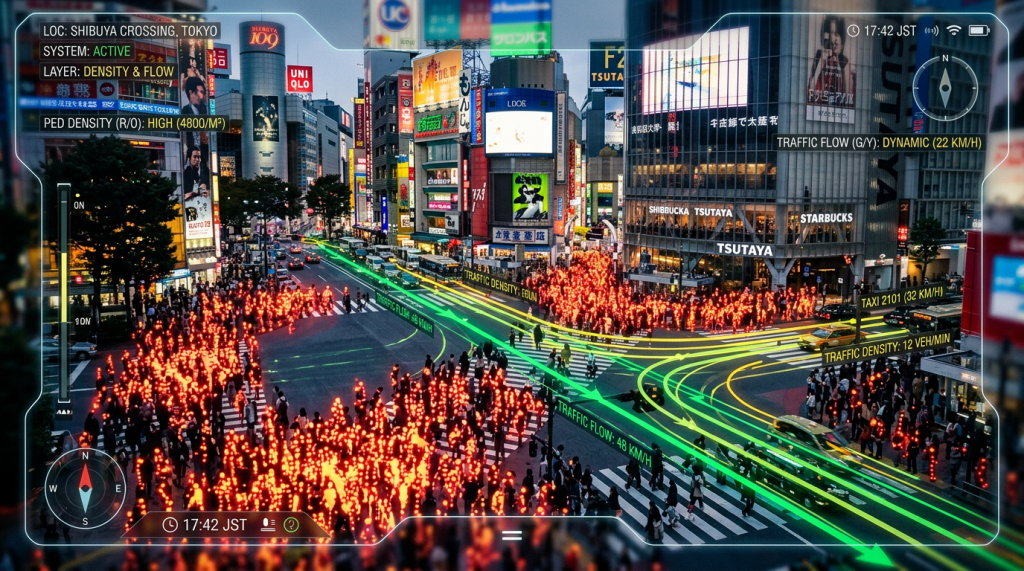
The scaling of cities is not just a niche demographic trend; it is the defining mechanism of our future civilisation. The mathematics discovered by Geoffrey West and his contemporaries prove that cities are not just passive places where people happen to live; they are complex, self-organising machines that magnify human potential and human flaws in equal measure.
As the global population hurtles towards a reality where over two-thirds of humanity resides in urban centres, understanding these scaling laws is critical. We must respect the fact that density is our greatest asset, generating the wealth, innovation, and infrastructure efficiency required to sustain billions of lives on a planet with finite resources. However, we must also remain deeply vigilant of the accelerating pace of life, the exponential spread of crises, and the environmental toll of unstructured growth. The future of the city, and by extension the future of humanity, relies entirely on our ability to master this urban equation – embracing the immense power of proximity while smartly engineering our way out of its darkest consequences.
Next week, we are investigating the role of multimodel mobility for the future of cities!
Ready to build a better tomorrow for our cities? I’d love to hear your thoughts, ideas, or even explore ways we can collaborate. Connect with me at info@fannimelles.com or find me on Twitter/X at @fannimelles – let’s make urban innovation a reality together!


Leave a Reply