The twenty-first century is defined by a collision of forces. On one side, we have rapid global urbanization; on the other, the relentless encroachment of the sea. As humanity clusters into coastal megacities, the ground beneath our feet is becoming increasingly unstable. Jakarta is sinking. Miami is battling “sunny day flooding.” Lagos and Bangkok are grappling with saline intrusion.
For decades, our response has been defensive: we build higher seawalls, pour more concrete, and dredge sand to “reclaim” land from the ocean. But these static defenses are proving to be temporary, expensive, and ecologically destructive battles against a dynamic force.
A profound shift in architectural and engineering thought is now underway. We are moving from the concept of fighting the water to living with it. Enter the era of floating cities—a transition from science fiction to a critical, flood-proof infrastructure necessity.
This isn’t just about survival; it is about evolution. Based on a comprehensive analysis of floating urbanism technologies and socio-economic implications, here is why floating cities represent the most promising frontier for the future of human habitation.
1. True climate resilience: Rising with the tide
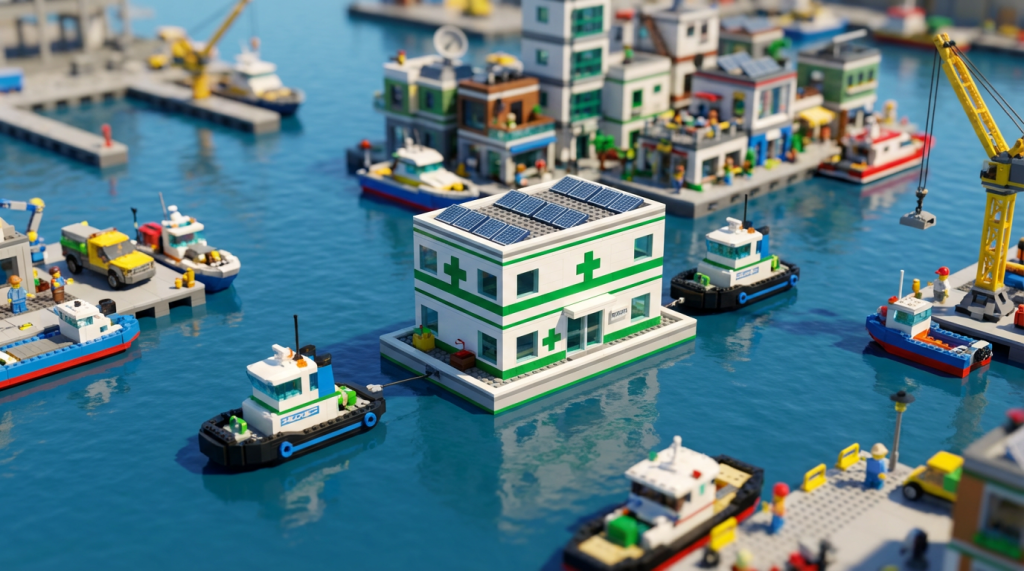
The most immediate argument for floating cities is existential. Coastal regions currently house over 40% of the global population, despite occupying only 20% of the Earth’s landmass. By 2050, sea levels are projected to rise significantly, threatening to displace roughly 630 million people. Traditional infrastructure is rigid. When sea levels rise or storm surges hit, seawalls eventually breach. In contrast, floating architecture is “amphibious.” These structures are designed to rise in sync with water levels, offering immunity to sea-level rise. Whether the ocean rises by one meter or five, the city rises with it.
This dynamic resilience extends to extreme weather. Projects like Oceanix Busan in South Korea are being engineered to withstand Category 5 hurricanes. By utilizing “slack mooring” systems, these cities are anchored to the seabed but possess enough flexibility to move with storm surges rather than snapping under the tension. This transforms the city from a brittle target into a flexible organism that rides out the storm.
Rutger de Graaf from Blue21 explained the connection between floating cities and coastal cities, highlighting the opportunities for the floating ones to increase the resilience of the coastal ones in Episode 384 on the What is The Future for Cities? podcast:
2. Solving the land scarcity crisis (without killing the ocean)
As coastal cities expand, they run out of room. The historical solution has been land reclamation—pouring billions of tons of sand into the ocean to create artificial ground. While effective in the short term, this process is ecologically devastating. It buries marine ecosystems, destroys coral reefs, and disrupts local fisheries.
Floating cities offer a sustainable alternative. They create new urban space without the need to bury the ocean floor.
- Speed and Efficiency: Unlike reclamation, which requires years for sand to settle, floating modules can be manufactured in shipyards and towed to the site, allowing for rapid deployment.
- Cost-Effectiveness: In deep waters, the cost of reclamation becomes exorbitant. Floating systems, however, decouple the cost of the “land” from the depth of the water. A study on Dubai’s Palm Jumeirah suggested that a floating system could have saved billions compared to the massive reclamation effort undertaken.
This approach allows cities to expand organically. The Oceanix Busan prototype, for instance, is designed to grow from a neighborhood of 12,000 residents to a metropolis of 100,000 through the addition of modular platforms, scaling with demand rather than requiring massive upfront terraforming.
3. Beyond sustainability: The promise of regeneration
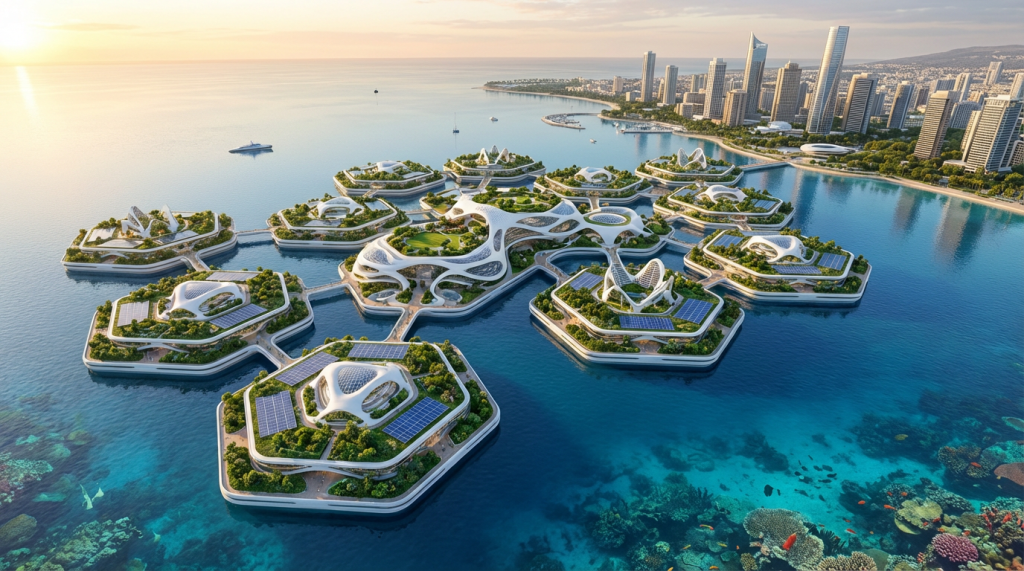
Perhaps the most exciting aspect of floating cities is their potential to be regenerative. The goal isn’t just to do less harm than a traditional city, but to actively heal the environment.
A standout innovation in this field is the use of Biorock technology (Mineral Accretion Technology). Traditional steel and concrete degrade in saltwater. Biorock, however, utilizes a low-voltage electrical current applied to submerged steel structures. This triggers a chemical reaction that causes limestone minerals found naturally in seawater to precipitate onto the steel. The result is a material that is three times stronger than standard concrete and, miraculously, self-repairing. If the structure cracks, the electrochemical process fills the gap with new mineral growth. Furthermore, this limestone coating provides an ideal substrate for corals and oysters, effectively turning the city’s foundations into thriving artificial reefs that boost local biodiversity.
These cities are being designed as closed-loop systems. Oceanix Busan, for example, aims to generate 100% of its operational energy on-site through floating photovoltaic panels and rooftop solar. Water is recycled, waste is converted into energy or compost, and food is grown in high-yield hydroponic towers, reducing the city’s reliance on complex, carbon-heavy supply chains.
Rutger de Graaf from Blue21 described this regenerative and productive nature of floating cities in Episode 384 on the What is The Future for Cities? podcast:
4. The “Blue Economy” and industrial innovation
Floating cities are not limited to residential neighborhoods; they are poised to become the engines of the Blue Economy.
Saudi Arabia’s Oxagon, part of the NEOM project, represents the industrial scale of this vision. Planned as the world’s largest floating structure, it is situated near the Suez Canal and is designed to revolutionize global logistics. By integrating “Industry 4.0” technologies—robotics, AI, and IoT—directly onto the water, Oxagon aims to create a seamless interface between maritime shipping and advanced manufacturing.
These floating hubs can host industries that thrive on water access:
- Marine Biotech & Research: Dedicated platforms for studying oceanography and climate change.
- Sustainable Aquaculture: 3D ocean farming beneath the platforms can produce seaweed and shellfish, which clean the water by absorbing excess nutrients while providing food security.
- Green Energy Hubs: Floating cities can act as batteries, aggregating power from offshore wind, floating solar, and Ocean Thermal Energy Conversion (OTEC) systems to power the mainland.
Rutger de Graaf from Blue21 described this new economic frontier on the What is The Future for Cities? podcast‘s Episode 384:
5. Biomimicry: Learning from nature
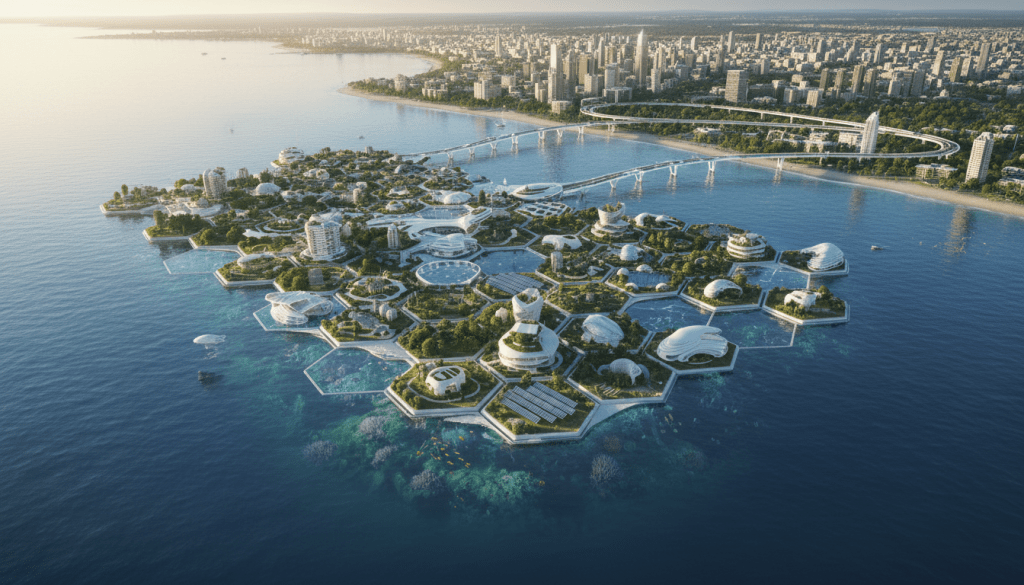
The design of these cities often rejects the rigid grid of the terrestrial metropolis in favor of biological forms. The Maldives Floating City (MFC) is a prime example. Facing the threat of total inundation by 2100, the Maldives is constructing a city modeled on brain coral. This isn’t an aesthetic choice; it is hydrodynamic engineering. The hexagonal, coral-like arrangement creates a network of canals that naturally dissipates wave energy. This significantly reduces the impact of storm surges on the housing units, proving that nature often holds the patent on the best survival strategies.
6. Social adaptability and “plug-and-play” infrastructure
The modularity of floating architecture offers a unique social benefit: mobility. In a traditional city, if a hospital or power plant is in the wrong place, moving it is impossible. In a floating city, critical infrastructure can be “plug-and-play.” Floating hospitals, schools, or desalination plants can be constructed in a shipyard and towed to wherever they are needed most—whether that’s a booming coastal city or a disaster zone recovering from a tsunami. This flexibility allows for “phased growth.” A community can start small and expand its territory by docking new modules. If a specific economic sector shrinks, those modules can be repurposed or moved, preventing the urban decay seen in “Rust Belt” cities on land.
7. Overcoming the “Grey Zones”
Of course, the path to this hydro-spatial future is not without challenges. Critics rightly point to the risks of greenwashing and the danger of creating elite “climate havens” that exclude the local working class. There are also significant legal hurdles. Under the United Nations Convention on the Law of the Sea (UNCLOS), floating cities sit in a legal limbo—neither fully “ships” nor “artificial islands.” This complicates property rights, insurance, and sovereignty. However, progress is being made. The Maldives has taken the lead by issuing title deeds for floating homes, creating a precedent for “water plots.” Meanwhile, the involvement of UN-Habitat in projects like Oceanix Busan signals a move away from libertarian “seasteading” fantasies toward state-sanctioned, legally recognized urban extensions.
Beyond legalities, there is a fierce strategic debate about where to break ground first, as it is discussed on Episode 393R of the What is The Future for Cities? podcast. A multi-criteria analysis of flood risk and population growth identifies Asian and African cities as having the most urgent need, with Guangzhou (scoring 11.36), Mumbai (7.31), and Lagos (5.25) topping the list for potential benefit. However, a paradox exists. While these cities face the imminent crisis, the technological expertise to build complex, circular floating systems is concentrated in “front-runner” regions like the Netherlands. This creates a tension between the moral obligation to deploy immediately in high-risk zones and the engineering necessity of perfecting the “Blue Revolution” technology in stable environments before exporting it.
A pragmatic evolution
The concept of the floating city has matured. It has moved beyond the 1960s utopian visions of Buckminster Fuller and the escapist dreams of early seasteaders. Today, it is a pragmatic response to a planetary emergency.
As sea levels rise, we have two choices: retreat or adapt. Floating cities represent the pinnacle of adaptation. They offer a way to preserve our coastal heritage, protect our economies, and regenerate our oceans simultaneously. By moving onto the water, we are not just building new houses; we are building a new relationship with our planet—one where we stop fighting the tide and learn to rise with it.
The technology exists. The engineering is sound. The only question remaining is whether we can ensure these new frontiers are open to all, turning the “Blue Frontier” into a home for humanity, not just a hideout for the few.
Next week, we are investigating the opportunities and challenges of special economic zones (ZEDEs), with Niklas Anzinger!
Ready to build a better tomorrow for our cities? I’d love to hear your thoughts, ideas, or even explore ways we can collaborate. Connect with me at info@fannimelles.com or find me on Twitter/X at @fannimelles – let’s make urban innovation a reality together!

 Vitruvian Solutions
Leave a reply to The age of amphibious cities: Why we must learn to live on the water – Lu's Energy Cancel reply