Cities are the most complex systems humanity has ever built. They are dense, dynamic, and non-linear networks of infrastructure, economies, and human behaviours. For a century, we’ve attempted to manage this incredible complexity with 20th-century tools: static master plans, siloed city departments, and a fundamentally reactive approach to maintenance.
That era is over. It’s no longer working.
The acute, compounding strains on our urban systems—from resource management and aging infrastructure to gridlocked mobility—demand a new model. We need a new urban operating system.
That new operating system is arriving, and it is powered by artificial intelligence.
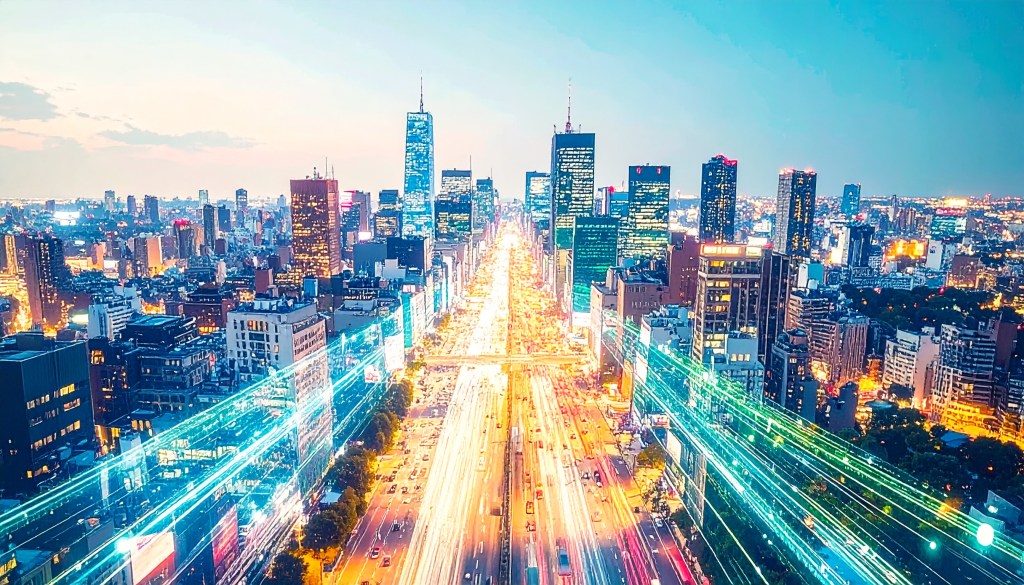
We are at the threshold of a profound transition, moving beyond the simple “smart city”—a disconnected collection of sensors and apps—to the Algorithmic Metropolis. This is a city that is not just automated, but cognitive. It is a system that can learn, predict, and adapt.
For city leaders, urban planners, and infrastructure operators, this transition represents a twofold revolution. The first part is happening right now: a radical optimization of the “present” and our core city operations. The second, and far more transformative, part is what’s next: an unprecedented ability to simulate the “future” and understand the consequences of our decisions.
This post explores this journey, from the engine room of urban operations to the new frontier of systemic foresight.
Decoding the new urban “alphabet soup”
Before we explore the “what,” we need to understand the “how.” The terms AI, ML, and LLM are often used interchangeably, but for a city leader, they represent three distinct, compounding capabilities.
Artificial Intelligence (AI) is the broadest concept—the “brain” of the entire operation. Think of it as the digital system’s capacity to perform tasks that normally require human intelligence: planning, problem-solving, and, most importantly, decision-making. In an urban context, a true AI would be the coordinating intelligence that, during a major storm, can simultaneously analyse power grid data, model flood patterns, re-route emergency services, and communicate with intelligent traffic signals, all to minimize disruption and protect public safety.
Machine Learning (ML) is the “pattern finder” that makes AI so powerful. It’s a subset of AI where systems are not explicitly programmed with rigid rules. Instead, they “learn” directly from vast amounts of data. The old way of building a system was: IF [vibration sensor 1] > 10, THEN [send alert]. The ML way is to feed the system years of sensor data from a thousand bridges, allowing it to learn the incredibly subtle, complex patterns of vibrations, acoustics, and temperatures that precede a structural failure. ML is what enables a system to go from simple automation to genuine prediction.
Large Language Models (LLMs) are the “universal interface.” This is the technology, like ChatGPT or Google’s Gemini, that has captured the world’s attention. LLMs are trained on massive datasets to understand, generate, and interact using natural, human language. Their power in a city context is that they make all the complex AI/ML systems accessible. A city planner no longer needs to be a data scientist to run a complex query. They can simply ask, “Summarize all public complaints about the new park in District 5 and cross-reference them with maintenance reports for that area.” The LLM acts as the “co-pilot,” translating human intent into a complex data request and providing the answer in clear, understandable prose.
The “Now” — AI as the ultimate optimization engine
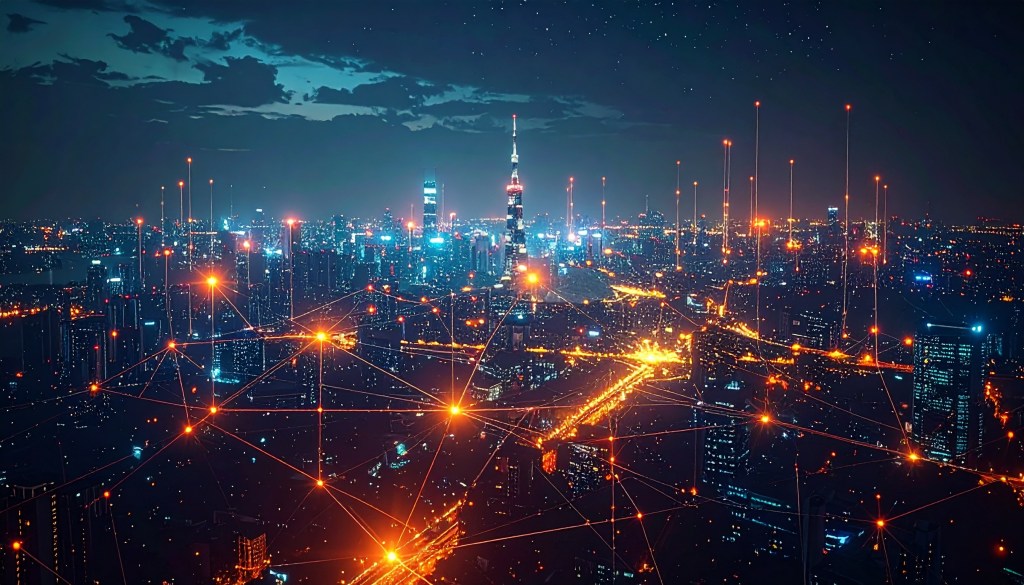
Today, this suite of technologies is already becoming the invisible, hard-working engine of the modern city. The primary focus is on optimization: making core operations dramatically more efficient, sustainable, and reliable.
But before we dive into the “how,” it’s critical to ask “why.” There’s a danger in pursuing “tech for tech’s sake”. The goal of a smart city isn’t just to be technologically advanced; it’s to be fundamentally more liveable.
This is a crucial distinction. When that human-centric goal is clear, the technology becomes a powerful enabler. In an interview (346I) on the What is The Future for Cities? podcast, Dr. Mina Sartipi explains how this work gets done, how a real-world smart city testbed functions, how to build the vital public-private-academic partnerships to fund it , and how to frame technology as an “enabler” that provides “observability” —all while being guided by civic engagement, not dictated by data:
This shift is most profound in our physical infrastructure, moving us from a reactive to a predictive state. For generations, city maintenance has been a “fix-it-when-it-breaks” model. AI and ML flip this script entirely. ML models, fed by acoustic sensors in water mains, can detect the unique sonic signature of a pinhole leak, allowing crews to fix it before it becomes a catastrophic main break. This saves billions of gallons of water and avoids the immense disruption of emergency repairs.
This same principle applies to the power grid. An AI-powered smart grid does more than just read meters. It actively forecasts energy demand at a neighbourhood level, factoring in weather, special events, and learned historical patterns. It can then dynamically route power, minimize waste, and—critically—seamlessly integrate volatile renewable sources like solar and wind, creating a more stable and sustainable grid.
We see this optimization in urban mobility as well. Traffic is a classic complex-systems problem. AI-driven intelligent traffic management systems replace static, timed signals with adaptive control. By analysing real-time camera feeds and GPS data, these systems function like a symphony conductor, adjusting signal timings on the fly to clear bottlenecks, prioritize a late-running public bus, or create a “green wave” for an approaching ambulance. This isn’t a static plan; it’s a living, learning system adapting to the city’s pulse.
And finally, LLMs are transforming the “soft” infrastructure of the city: its bureaucracy. They are becoming the new interface for both citizens and staff. For the public, this means 24/7 chatbots that can actually handle complex service requests in natural language, from processing a business permit application to diagnosing a utility billing issue. For city staff, LLMs are a powerful “co-pilot.” They unlock the immense value buried in a city’s unstructured data—decades of public comments, inspection reports, and policy documents—allowing planners to analyse trends and get answers in seconds, not months.
This is a fundamental shift from static planning to “AI Urbanism,” where the city itself becomes a “self-evolving” entity. The WT4Cities? podcast’s research summary (367R) on AI in urban transit offers a powerful analysis of how AI is being used to uncover and manage the deep, “non-linear urban relationships” in transportation, addressing complex spatiotemporal imbalances and paving the way for a “human-machine symbiotic model” of urban management:
The “Catch” — Navigating the new operational risks
As consultants advising on these transformative projects, we would be failing our clients if we only sold the upside. This new, hyper-connected efficiency creates a new and dangerous class of operational risks. Acknowledging them is the first step to mitigating them.
The most obvious is the creation of a new, high-stakes cybersecurity landscape. When your power grid, water supply, and traffic systems are all AI-driven and interconnected, a cyberattack is no longer a simple data breach. It becomes a physical event. Hacking a city’s traffic network isn’t about stealing personal information; it’s about causing a 100-car pileup or city-wide gridlock. A successful attack on a smart grid could trigger a blackout. The stakes have moved from digital to physical, and our security models must evolve to match.
This deep interconnection also creates the peril of systemic risk. The very integration that provides such radical efficiency also creates a potential single point of failure. In a tightly coupled, AI-managed city, a failure in one system can cascade catastrophically. A single, subtle software glitch in the grid’s AI could shut down the water pumps, which in turn disables the cooling systems for the city’s data centres, which then brings down the entire traffic, communications, and emergency response network. We are engineering cities that are incredibly efficient, but we must work just as hard to ensure they remain robust.
Finally, there is the governance challenge of the “black box.” Many advanced ML models, particularly in deep learning, are opaque. Even their creators cannot fully explain how they arrived at a specific decision. This is a massive liability in a high-stakes urban environment. Imagine a model flags a billion-dollar bridge for immediate, emergency closure based on its analysis of sensor data. If that model cannot explain its reasoning to a chief engineer, what does she do? Trust an unexplainable algorithm with the city’s economy and public safety? This is a profound decision-making and liability problem that we must solve with new standards for “explainable AI” (XAI), also discussed in episode 345R on the What is The Future for Cities? podcast:
The “Next” — AI’s true power isn’t optimization, it’s experimentation
Running our current cities better is a massive, necessary win. But it is only half the story. The true, paradigm-shifting potential of AI in urbanism is not in optimizing the present. It’s in gaining the ability to understand the future through experimentation. For as long as cities have existed, planners have been haunted by the law of unintended consequences. We are forced to make multi-billion-dollar decisions, blind to the long-term ripple effects. We call these second and third-order consequences.
Consider this classic, relatable urban planning story.
- A First-Order Decision: A city is choked by traffic. To solve it, leaders approve a $2 billion plan to build a new highway from the suburbs to downtown. The intended result is clear: reduced commute times.
- The Second-Order Consequence: The highway is a success. Commute times drop. This makes the suburbs more attractive, so property values near the new exits rise. New commercial developments and housing tracts spring up.
- The Third-Order Consequence: This new development encourages “urban sprawl.” More people move even further out, creating new and longer commutes. Within 15 years, the new highway is just as congested as the old roads. The city solved its short-term traffic problem by creating a much larger, long-term problem: a less dense, less efficient, and more expensive-to-maintain metropolitan area.
This is the planner’s dilemma. We have been unable to see these emergent, long-term effects. Until now.
This is the new frontier where companies are actively building AI-powered modeling tools specifically for this challenge. In a recent interview (368I) on the What is The Future for Cities? podcast, Josh Rands, CEO of TerraCity, discusses how his company is developing tools to help cities with comprehensive planning across transportation and land use, specifically to model the complex, cohesive system of cities and the environment and finally get a handle on those elusive “first, second, and third rate consequences”:
Inside the “crystal ball” — How algorithmic foresight works
We are now building and deploying the tools to make these invisible consequences visible. This is not an oracle predicting a single future; it is a simulation engine for running plausible futures. This technology combines two core components.
The first is the Digital Twin. This is the stage, or the game board. Pioneered in cities like Singapore, a digital twin is not a static 3D map. It is a living, breathing, high-fidelity virtual replica of the entire city’s systems. It knows the real-time location of every bus, the real-time energy load on every building, the current pressure in every water pipe, and the second-by-second flow of traffic.
The second component is Agent-Based Modelling (ABM). These are the actors. We populate this digital twin with millions of autonomous AI “agents” that represent the city’s actors: individual commuters, delivery drivers, businesses, and households. These agents aren’t given simple paths to follow; they are given complex goals (e.g., “get to work on time,” “find a new apartment,” “maximize profit”) and the ability to make intelligent decisions based on the virtual world around them.
This is where the magic happens. A planner can now stand before this “crystal ball” and ask: “What if…?”

Let’s run our scenario. A planner proposes to rezone a large, central industrial district for high-density residential use. Instead of guessing, they input that policy into the digital twin and run the simulation, fast-forwarding 10 years into the future in just a few hours.
- First, the 1st-order effect appears: The simulation shows new residential towers rising in the district, just as planned.
- Then, the 2nd-order effects emerge: The new AI “commuter” agents, now “living” in these towers, flood the local subway station. The model’s dashboard for that station flashes red: “CAPACITY EXCEEDED.” The AI “traffic” agents, driving from the new towers, create new, persistent gridlock on two nearby bridges.
- Finally, the 3rd-order effects materialize: As the simulation runs forward, the model shows the constant, heavy traffic on those bridges is causing a problem. The city’s own predictive maintenance algorithm, now running inside the simulation, flags those bridges for “accelerated wear-and-tear,” showing their maintenance-cost forecast tripling. The air quality model for the adjacent, downwind neighbourhood turns red from the new, idling traffic.
The planner can see the cascading failure. But they can also fix it. They rewind the simulation, but this time, they add a new dedicated bus-only lane, upgrade the local power substation, and implement a congestion charge on the bridges. They run the simulation again. This time, the subway station is green, the traffic flows, and the maintenance forecast is stable.
They have found the optimal policy, de-risked a billion-dollar decision, and saved a future generation from their unintended consequences.
The city of tomorrow is built today
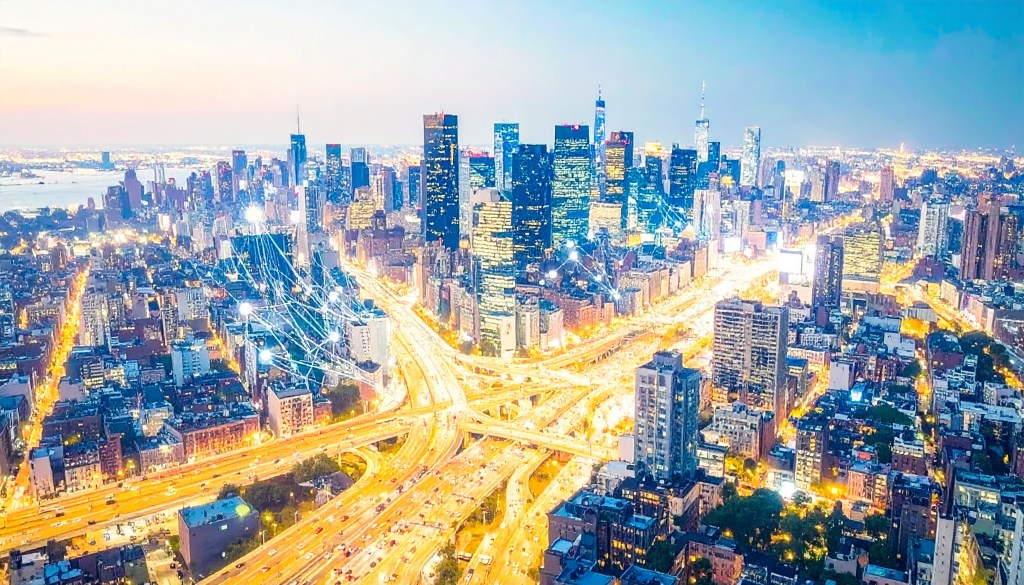
The Algorithmic Metropolis is no longer science fiction. The technologies are here. The challenge for city leaders is no longer about if they should adopt AI, but how they can build a coherent strategy.
The cities that thrive in the 21st century will not just be “smart”; they will be “prescient.” They will be the ones that move beyond simply optimizing their present operations and boldly embrace the power to simulate, test, and design their future.
The challenge is to look beyond just buying the next piece of tech. It’s time to build a robust strategy for foresight.
It’s time to start asking “What if…?” and finally get an answer.

Ready to build a better tomorrow for our cities? I’d love to hear your thoughts, ideas, or even explore ways we can collaborate. Connect with me at info@fannimelles.com or find me on Twitter/X at @fannimelles – let’s make urban innovation a reality together!
 Vitruvian Solutions
Leave a comment