How do we ensure our cities aren’t just changing but evolving in the right direction?
While cities are always evolving, it’s worth asking: is this evolution intentional, or are we simply reacting to whatever comes our way? This question holds the key to shaping the cities of tomorrow—places where communities thrive, nature and infrastructure coexist, and progress doesn’t leave anyone behind.
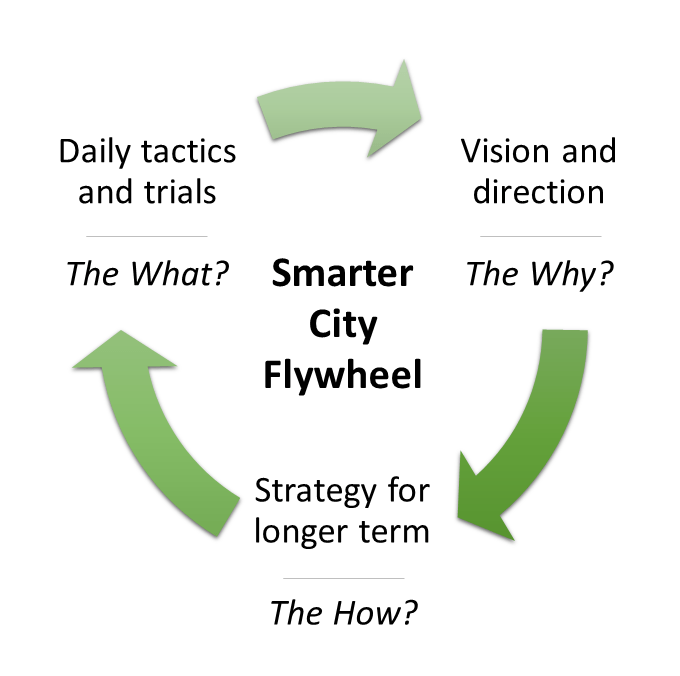
To build a better future, we must be intentional in our approach. I believe the key lies in creating what I call the “Smarter City Flywheel”—a framework that connects vision, strategies, and tactics (the Why, How, and What of cities) in a self-reinforcing loop that guides cities toward their ideal futures.
Cities and Their Need for a Vision
Cities are the embodiment of human ingenuity and interaction, yet they’re often viewed as static products—finished once built. In reality, cities are never truly complete. Like and with us, they grow, adapt, and respond to the changing needs of their inhabitants and environments. Cities consist of more than just buildings, roads, and utilities. They are living ecosystems that thrive when nature and people interact in balance. Think about the spaces where greenery thrives, where you can see the seasons change or enjoy a park—those are the places we cherish most. Cities are networks of these networks.
But urban evolution doesn’t happen by itself. For cities to truly flourish, we can and should be proactively shaping their growth. The future will come regardless, but how that future looks depends on whether we consciously guide it or let it unfold haphazardly.

The Vision: Why Cities Need Long-Term Goals
To steer the future, cities must have a clear vision—a long-term goal that serves as their North Star (Richard Gill talks about the North Star as the direction in the WTF4Cities? Podcast 274th episode). This vision answers the critical question: Why are we building this city, and what do we want it to become?
Importantly, this vision is not a one-size-fits-all solution. Each city’s vision will differ based on its unique character, resources, and people. However, the key is that this vision must be ambitious, motivating, and broad enough to allow for adaptability over time. For example, rather than aiming for a “smart city” (a term that implies a static, finished product), I advocate for aiming toward “smarter cities,” emphasising that evolution is continuous and there’s always room for improvement.
The vision should also look far ahead—at least 50 years into the future. A long-term outlook encourages collaboration across generations, allows time for meaningful change, and prevents us from getting caught up in the short-term issues that often dominate urban planning.
But vision-making can’t rest solely in the hands of government officials or city planners. It needs to involve a wide range of stakeholders, including urban professionals, residents, and community members. When people feel they’ve contributed to a city’s vision, they are more likely to invest in its success and champion its progress.
Strategies: The How of Urban Evolution
With a vision in place, the next step is developing strategies—the how of turning that vision into reality. Strategies provide the roadmap for achieving long-term goals but must remain flexible enough to adjust as circumstances change.
These strategies should span 5-10 years, creating mid-range building blocks toward the larger vision. However, it’s vital that these strategies are revisited regularly. A strategy that no longer aligns with reality becomes a stumbling block rather than a stepping stone. It’s also crucial that strategies across different sectors of the city—transport, housing, energy—are interconnected. Without coordination, cities risk duplicating efforts or missing opportunities to leverage resources effectively.
Haydn Read, a specialist practitioner in systems thinking and action, talked about the challenges of the How in the 260th episode of the What is The Future for Cities? podcast.
Tactics and Experiments: Building Momentum
Finally, we get to the level of tactics and experiments—the what of city planning. These are the short-term actions (typically within a 5-year window) that serve as the smaller building blocks of change.
At this stage, cities must experiment, as Michael Healy describes their department at Christchurch City Council (he talked about this in episode 165 on the WTF4Cities? Podcast). Trial new ideas, test out innovations (such as new technologies), and allow room for small failures. These experiments are crucial because they allow for learning and course-correcting without massive disruption. If we don’t allow for mistakes at the tactical level, we risk making catastrophic missteps at higher levels that could derail the city’s evolution entirely.
Tactics should also be measurable. Key performance indicators (KPIs) help determine whether a city is truly moving in the direction outlined by the vision. Without tangible markers of progress, it becomes difficult to assess whether the efforts are paying off or if new approaches are needed.
The Smarter City Flywheel: A Self-Reinforcing Feedback Loop
Once a vision is set and strategies and tactics are in place, they should form a flywheel—a continuous, self-reinforcing loop. The vision directs strategies and tactics, while the outcomes of these experiments and actions provide valuable feedback to refine the vision itself. This iterative process keeps the city’s evolution dynamic and responsive.
As the city grows and changes, this flywheel gains momentum, continuously moving the city closer to its vision while acknowledging that the journey never truly ends. There will always be more to learn, more to improve, and more opportunities to evolve. A city that stops evolving is, in essence, a city that stops living.
Are We Ready to Guide Urban Evolution?
We are at a critical juncture in urban development. The question is not whether our cities will change, but whether we will guide that change consciously or let it happen to us. The Smarter City Flywheel is a framework for ensuring that urban evolution is intentional, inclusive, and always progressing toward a better future.
Food for thought:
- What is the vision for your city?
- Have you seen strategies and experiments that are clearly aligned with long-term goals?
- How do you think cities can better engage their communities in shaping these visions?
Let’s start the revolution about how we can ensure that urban evolution works for all of us.
 Vitruvian Solutions
Leave a comment