Imagine stepping out of your front door on a crisp morning. Instead of walking to your garage, navigating the stress of peak-hour traffic, and endlessly circling city blocks in search of a parking spot, a sleek, quiet pod pulls up to your kerb exactly when you need it. You step inside, catch up on emails or simply enjoy your coffee, and are dropped off seamlessly at your destination. The vehicle then glides away to pick up its next passenger. This isn’t a scene from a science fiction film; it is the highly anticipated reality of autonomous vehicles (AVs). As we stand on the precipice of a revolution in urban transport, it is crucial to understand that self-driving technology will not just change how we travel—it will fundamentally rewrite the physical and social fabric of our cities.
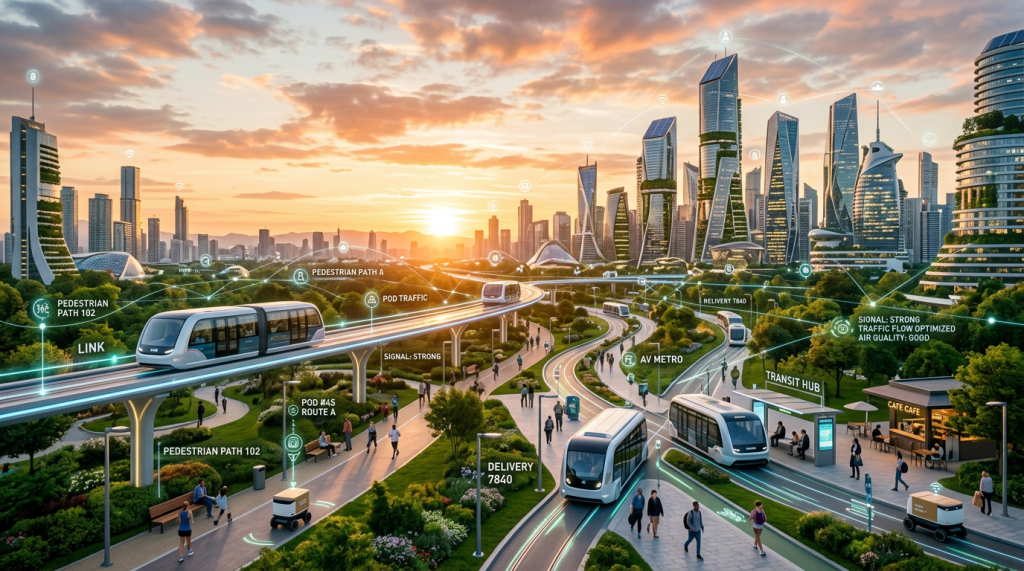
Beyond the self-driving car: Understanding the autonomous ecosystem
When most people hear the term “autonomous vehicle”, they immediately picture a private car without a steering wheel. While passenger cars are certainly a major part of the puzzle, the true future of urban mobility is far more diverse and interconnected.
To truly grasp the impact of this technology, we need to look at the broader ecosystem:
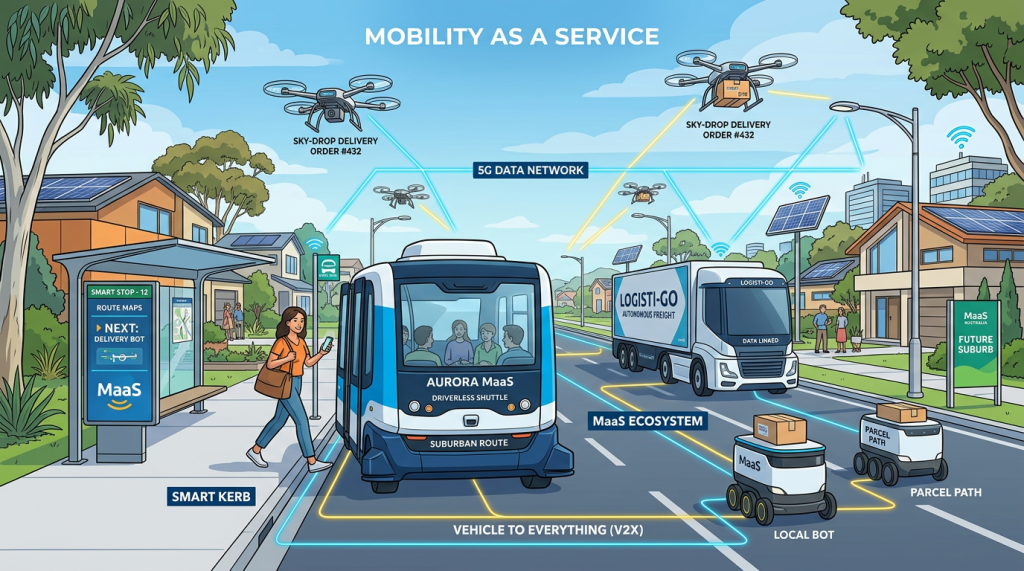
- Autonomous public transport: The most profound changes will likely be seen in public transit. We are already seeing trials of autonomous shuttles and buses operating on fixed routes in various cities around the world. In the future, these vehicles could operate on-demand, providing crucial “last-mile” connectivity that links suburban homes to major train stations or tram lines.
- Freight and delivery vehicles: From heavy-duty long-haul trucks to small, esky-sized delivery bots navigating the pavement, autonomous logistics will transform how goods move through our urban centres, potentially operating overnight to reduce daytime congestion.
- Connected autonomous vehicles (CAVs): This is where the magic truly happens. CAVs do not just use sensors to see the world around them; they actively communicate with it. Through “Vehicle-to-Everything” (V2X) technology, CAVs speak to other cars, traffic lights, pedestrian crossings, and central city grids. This interconnected web allows vehicles to anticipate traffic flows, avoid collisions before they happen, and travel safely at coordinated speeds.
Episode 413R debates the impacts of connected and autonomous vehicles on the What is The Future for Cities? podcast:
The drawbacks: Bumps along the road
Despite the utopian vision, the road to full autonomy is fraught with significant challenges and potential pitfalls that we must navigate carefully.
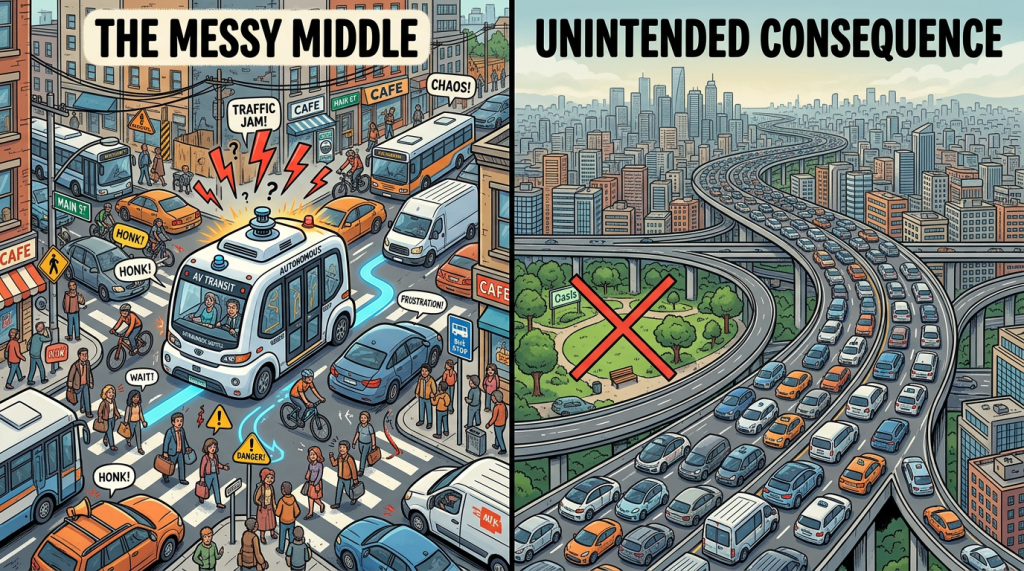
The “messy middle” transition period
We will not wake up one day to find all human drivers replaced by robots. There will be a lengthy transition period—potentially lasting decades—where highly logical, rule-abiding AVs must share the road with unpredictable human drivers, cyclists, and pedestrians. This mixed-traffic environment is incredibly complex for artificial intelligence to navigate and could initially lead to confusion and accidents.
The threat of induced demand and urban sprawl
There is a well-documented phenomenon in urban planning called “induced demand”: if you make driving easier and cheaper, more people will do it. If people can sleep or work during their commute, they might be willing to live much further away from the city centre. This could lead to massive urban sprawl and an increase in total vehicle kilometres travelled, potentially offsetting the environmental benefits of electric AVs.
Job displacement and economic shifts
The shift to autonomous transport will undoubtedly disrupt the economy. Millions of jobs globally—from taxi and truck drivers to mechanics and parking inspectors—will be rendered obsolete or fundamentally changed. Society must be prepared to support and retrain workers whose livelihoods are tied to the manual operation of vehicles.
Cybersecurity and data privacy
A city filled with connected, autonomous vehicles is essentially a massive, moving computer network. This makes it a prime target for cyberattacks. A malicious hack into a city’s AV grid could be catastrophic. Furthermore, the sheer volume of data these vehicles collect regarding our movements and habits raises profound privacy concerns that governments must address.
The benefits: Why we should welcome the driverless future
The transition to autonomous transport promises a wealth of benefits that could make our cities safer, cleaner, and more accessible.
Unprecedented road safety
Human error is a contributing factor in the vast majority of road accidents. Whether it is distraction, fatigue, or impaired driving, humans are inherently flawed behind the wheel. Autonomous vehicles, equipped with 360-degree cameras, radar, and LiDAR, do not blink, do not get tired, and do not look at their mobile phones. While no system is entirely foolproof, a fully mature AV network has the potential to drastically reduce road fatalities and injuries.
Reclaiming the urban landscape
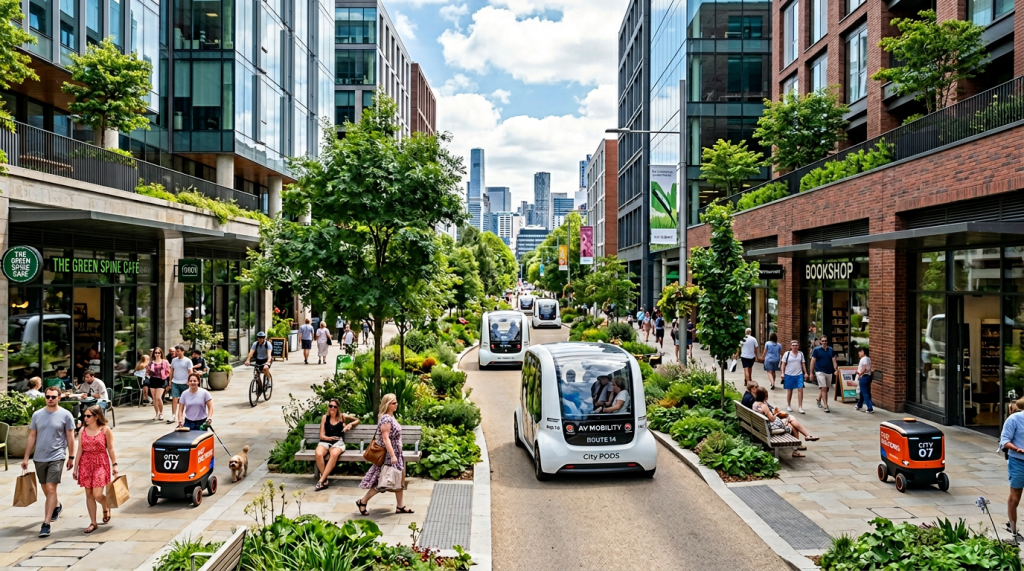
Currently, a massive percentage of prime real estate in our cities is dedicated to storing empty, stationary metal boxes. If we shift towards shared autonomous fleets, the need for sprawling car parks and endless miles of kerbside parking diminishes rapidly. This presents a once-in-a-generation opportunity to reclaim city space. Asphalt jungles can be transformed into green parks, wider footpaths, dedicated cycling lanes, and vibrant community spaces.
Enhanced accessibility for all
For individuals who cannot drive due to age, disability, or medical conditions, our current transport system can be incredibly isolating. Autonomous vehicles promise a new level of independence and mobility accessibility, allowing the elderly and disabled to travel safely and conveniently without relying on others.
Smoother traffic and environmental gains
Through the power of CAVs, traffic jams could become a relic of the past. Vehicles that communicate with one another can accelerate and brake in perfect unison, eliminating the “phantom traffic jams” caused by a single driver braking too hard. Furthermore, the vast majority of future AVs will be electric. When paired with smoother traffic flows and a shift towards shared mobility, this will lead to a significant reduction in urban air pollution and greenhouse gas emissions.
Cormac McKay talked about different use cases for autonomous vehicles in episode 414I on the What is The Future for Cities? podcast:
Preparing our cities: What we need to keep in mind
We cannot simply drop autonomous vehicles onto our existing 20th-century roads and expect optimal results. To truly harness the benefits and mitigate the drawbacks of AVs, city planners, policymakers, and citizens must start preparing today.
Upgrading physical and digital infrastructure
Our analogue roads need a digital upgrade. This means investing in “smart” infrastructure, such as traffic lights that can broadcast their status to approaching vehicles, and ensuring road markings and signage are meticulously maintained so machine-vision cameras can easily read them. We also need robust, high-speed 5G (and eventually 6G) networks to handle the immense data flow required by CAVs.
Rethinking kerbside management
As the need for traditional parking drops, the demand for “drop-off” and “pick-up” zones will skyrocket. Cities need to dynamically manage kerb space. A stretch of kerb might be an autonomous delivery zone at 5:00 AM, a passenger drop-off zone at 8:00 AM, and a space for a pop-up cafe at midday.
Implementing robust legislation and policy
We need forward-thinking regulations that dictate how AVs operate. Who is liable in the event of an accident—the “driver”, the software developer, or the vehicle manufacturer? How do we ensure that algorithms don’t inadvertently discriminate against certain neighbourhoods by providing poorer service? We must also establish strict policies around data ownership and privacy.
Prioritising public transport and active travel
The biggest risk of the AV revolution is that we simply replace human-driven traffic jams with robot-driven traffic jams. To prevent this, city planners must ensure that AV policies actively prioritise shared rides and high-capacity autonomous public transport over zero-occupancy “zombie cars” circling the block. Furthermore, the redesign of our streets must prioritise the safety and comfort of pedestrians and cyclists above all else.
The arrival of autonomous vehicles represents a profound shift in how we will live, work, and interact with our urban environments. From on-demand public shuttles to connected fleets that speak to our traffic grids, AVs offer immense potential to make our cities safer, greener, and more accessible. By drastically reducing human error, smoothing out traffic flows, and allowing us to reclaim vast expanses of parking space for community use, the benefits are undeniable. However, we must remain clear-eyed about the challenges. We will need to navigate a messy transition period with human drivers, defend against cybersecurity threats, manage potential job losses, and fight the urge to sprawl further into the countryside.
The future of our cities is not predetermined by the technology itself, but by how we choose to integrate it. If we leave it entirely to market forces, we risk repeating the mistakes of the past century—building cities for cars rather than for people. But if we plan proactively, update our infrastructure, and implement thoughtful policies, we can steer this technology toward a safer, more sustainable, and highly connected future.
The transition to an autonomous future will impact every single one of us, from our daily commutes to the safety of our streets. Don’t be a passive passenger in this journey.
Next week, we are investigating the arts and business industries connection to the future of cities through Africa’s example!
Ready to build a better tomorrow for our cities? I’d love to hear your thoughts, ideas, or even explore ways we can collaborate. Connect with me at info@fannimelles.com or find me on Twitter/X at @fannimelles – let’s make urban innovation a reality together!
 Vitruvian Solutions
Leave a comment