When you look out your window at the city around you, what do you see more of: life-giving nature, or lifeless concrete?
For over a century, the answer for most urban dwellers has been an overwhelming amount of the latter. We have built our cities as fortresses against the elements, channelling water through buried pipes, sealing the ground with asphalt, and conquering the heat with energy-intensive machinery. This philosophy – managing the environment through hard engineering – gave us the modern metropolis. But as our climates shift, bringing fiercer storms and deadlier heatwaves, these rigid systems are beginning to crack.
The future of cities depends on a crucial choice. Will we continue to rely solely on the grey engineering that got us here, or will we invite the green systems of the natural world back into our urban cores? The answer is not a simple choice between one or the other, but rather a revolutionary synthesis of both: grey and green Infrastructure.
To plan the cities of 2050, we must first understand what these systems are, where they succeed, where they fail, and ultimately, how they must work together to ensure urban survival.
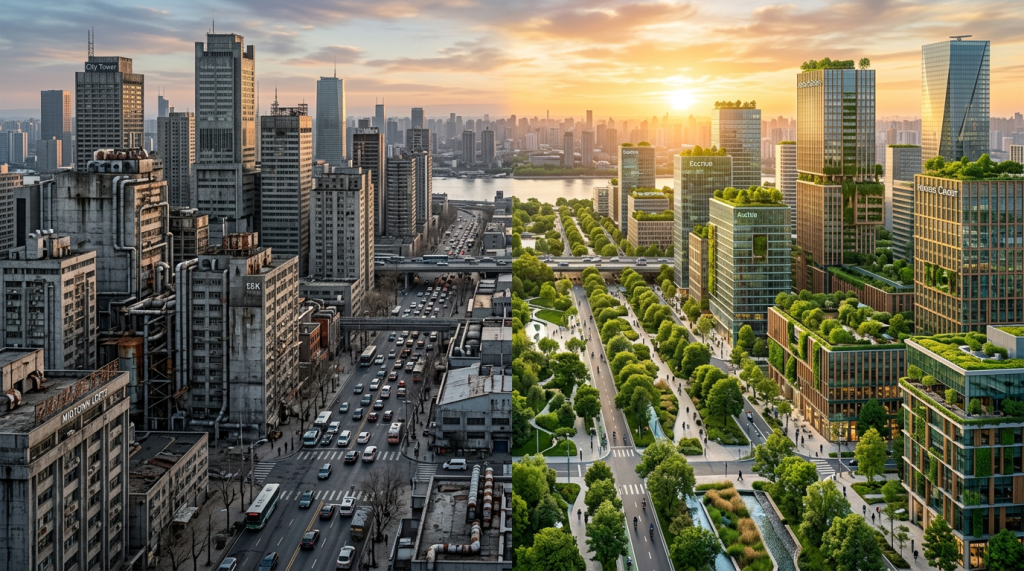
Defining the field: What are grey and green infrastructure?
At its simplest, grey infrastructure refers to the traditional, human-engineered structures that form the backbone of urban municipal services. The label “grey” comes from the primary material used: concrete, alongside steel, iron, and asphalt. These are centralized, single-purpose systems designed specifically to manage resources – particularly water – by moving them as quickly as possible from one point to another. Think of the unseen world beneath your feet: the intricate network of stormwater drains, combined sewer systems, water treatment plants, massive concrete dams, reservoirs, dikes, and levees. On the surface, grey infrastructure includes the paved streets, highways, and parking lots that define our landscape. The core philosophy here is conquest and control.
Conversely, green infrastructure refers to strategically planned networks of natural and semi-natural areas designed to deliver a wide range of ecosystem services. It mimics the natural hydrological and ecological processes that urbanization typically destroys. While grey infrastructure moves water away, green infrastructure seeks to capture, absorb, filter, and reuse water where it falls. It is decentralized, multifunctional, and “soft.” Examples include:
- Green roofs: Rooftops covered with vegetation that absorb rainwater and insulate buildings.
- Rain gardens/bioretention cells: Depressions in the landscape planted with native vegetation that collect and filter runoff from impervious surfaces like roofs or streets.
- Permeable pavement: Special types of asphalt or pavers that allow water to seep through into the ground rather than pooling on the surface.
- Urban forests and street trees: Large canopies that shade the city, filter air, and reduce runoff through their roots.
- Constructed wetlands: Artificial wetlands designed to treat wastewater or stormwater naturally.
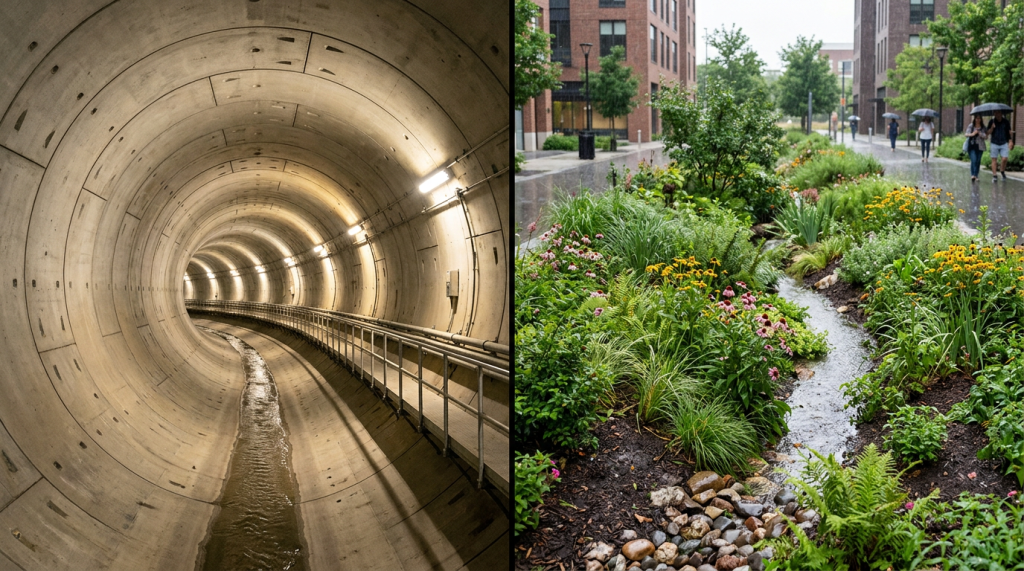
The titans clash: Comparing the approaches
Grey and green infrastructure are often presented as opposing philosophies, and they are indeed differentiated by their methods, scale, and outcomes.
| Feature | Grey infrastructure | Green infrastructure |
| Material | impervious (concrete, steel, asphalt) | pervious (soil, plants, water) |
| Philosophy | control, resist, convey away | adapt, absorb, infiltrate, reuse |
| Scale | centralized, large-scale, singular | decentralized, small-scale, networked |
| Flexibility | rigid, static, monolithic | flexible, living, adaptive |
| Failure mode | “fails colossally” (breach, overflow) | gradual loss of function, adaptive |
| Primary goal | single-purpose (e.g., flood protection) | multifunctional (eco-services) |
The comparison boils down to predictability versus versatility. Grey infrastructure is designed with engineered precision. You know exactly how many gallons of water a 30-inch pipe can handle per minute. However, it only performs that one function. Green infrastructure, while its capacity may vary depending on the health of the plants or the season, provides a dozen co-benefits simultaneously.
Episode 411R of the What is The Future for Cities? podcast compares the two approaches with real life examples from Florida:
The case for concrete: Advantages of grey infrastructure
Despite the rising popularity of nature-based solutions, grey infrastructure has dominated for a reason: it works exceptionally well for its primary intended purposes, especially in high-density areas.
1. Reliable and predictable performance
The foremost advantage of engineered systems is predictability. Urban engineers can model storm events and design concrete drainage basins or treatment plants to precise specifications. When a catastrophic storm approaches, there is value in knowing the exact structural capacity of the seawall or the levee protecting the neighbourhood. Grey infrastructure provides a measurable sense of security that living systems, which are subject to environmental variability, can struggle to match.
2. Space efficiency in dense cores
In densely packed city centres, where every square foot of surface is accounted for, underground pipes and centralized treatment facilities are often the only viable option. Paving a road with permeable asphalt requires a specific sub-base that may not be feasible above existing utilities. Grey systems allow cities to build “up” by burying their essential water management systems “down.”
3. Immediate efficacy and established management
When a new drainage pipe is laid or a new pumping station is built, it provides its full capacity immediately upon completion. It doesn’t need years to “mature” like a newly planted street tree or a rain garden. Furthermore, grey assets have established financial models for depreciation, lifespan calculation, and municipal maintenance schedules.
The Achilles heel of hardness: Disadvantages of grey infrastructure
However, the “build it and forget it” mentality of the 20th century has revealed severe, long-term flaws, particularly as climate scenarios change.
1. Inflexibility and the “false sense of security”
Grey systems are designed for static, historical climate data. A drainage network built for a “1-in-100-year” storm in 1950 may be overwhelmed by the “new normal” storms of today. Because they are rigid, they cannot easily adapt to these new extremes. Furthermore, hard structures like levees sometimes create a “false sense of security,” encouraging development in hazardous floodplains because residents assume the concrete will always hold. When a grey system does fail – such as a levee breach – the result is often sudden and catastrophic.
2. High capital, maintenance, and energy costs
Grey infrastructure is incredibly expensive to build and, increasingly, expensive to maintain. Aging infrastructure in many Victorian-era cities is failing, requiring trillions in replacement costs globally. These centralized systems are also massive energy consumers, requiring electricity to pump water over vast distances and operate energy-intensive treatment processes.
3. Transferring pollution, not treating it
The fundamental flaw of many urban stormwater systems (especially Combined Sewer Systems, or CSS) is that they move pollution. When a heavy storm hits, the system captures oily street runoff, heavy metals, and litter, mixing it with raw sewage. Often, the system becomes overwhelmed, resulting in a Combined Sewer Overflow (CSO) – dumping billions of gallons of untreated, toxic effluent directly into local rivers, lakes, and oceans.
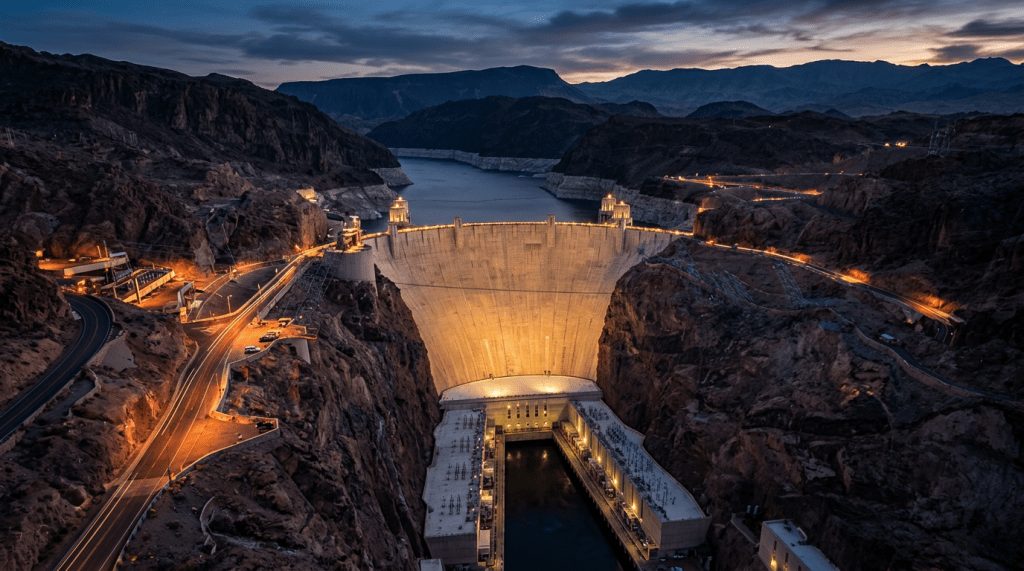
The case for nature: Advantages of green infrastructure
The “green” revolution is driven by the recognition that living systems offer a suite of benefits that concrete cannot replicate.
1. Multifunctionality and co-benefits
The single greatest advantage of green infrastructure is that it is multipurpose. A rain garden does not just manage stormwater. While doing so, it also:
- Filters pollutants: Soil and plants naturally break down hydrocarbons, metals, and nutrients.
- Alleviates urban heat island (UHI) effect: Through evapotranspiration, plants cool the surrounding air.
- Improves air quality: Trees capture particulate matter and absorb CO2.
- Creates habitat: Urban greenery supports pollinators and biodiversity.
- Enhances mental health: Access to nature in cities is linked to reduced stress and better well-being.
2. Climate resilience and adaptability
Living systems are adaptable. As climate change brings wetter winters or hotter summers, healthy green systems can often adjust their capacities or resilience over time. Mature urban forests provide significantly more shading and stormwater uptake than they did when first planted. Green systems lack the “hard failure point” of a pipe; if a rain garden is overwhelmed, it simply becomes a pond temporarily, detaining water rather than allowing it to flash-flood down the street.
3. Cost-effectiveness and longevity
In many scenarios, green infrastructure is cheaper to install than a comparable grey system, especially when accounting for co-benefits. Because they are living, green systems can actually increase in value over time, unlike grey systems, which begin to depreciate and degrade the moment they are completed.
Overgrowth challenges: disadvantages of green infrastructure
Despite its many co-benefits, green infrastructure is not a panacea and has unique drawbacks that must be managed.
1. Space requirements and surface conflicts
To maximize efficiency, green infrastructure needs to be distributed throughout the city on the surface. In crowded cities, finding the space for rain gardens, street trees, or constructed wetlands means competing with space for parking, sidewalks, or building footprints.
2. Maintenance and uncertainty of performance
Unlike a pipe, a garden requires regular, skilled horticultural care. If a rain garden is not weeded, pruned, or monitored for soil clogging, it can quickly become an eyesore or a failure point. Furthermore, the capacity of a living system is inherently more variable. We know how much water a specific soil mix can hold, but its effectiveness changes with the season, the health of the plants, and the compaction of the soil over time, making exact performance modeling more difficult.
3. High initial costs of specific applications
While some green solutions are cheap, others are expensive. A extensive green roof system, for example, requires significant structural reinforcement of the underlying building, which can make the initial capital cost prohibitive compared to a traditional conventional roof.
Louis de Jaeger, CEO of Commensalist, talks about the benefits of green infrastructure and compare it to its grey counterpart in episode 412 on the What is The Future for Cities? podcast:
The hybrid city: The blueprint for the future
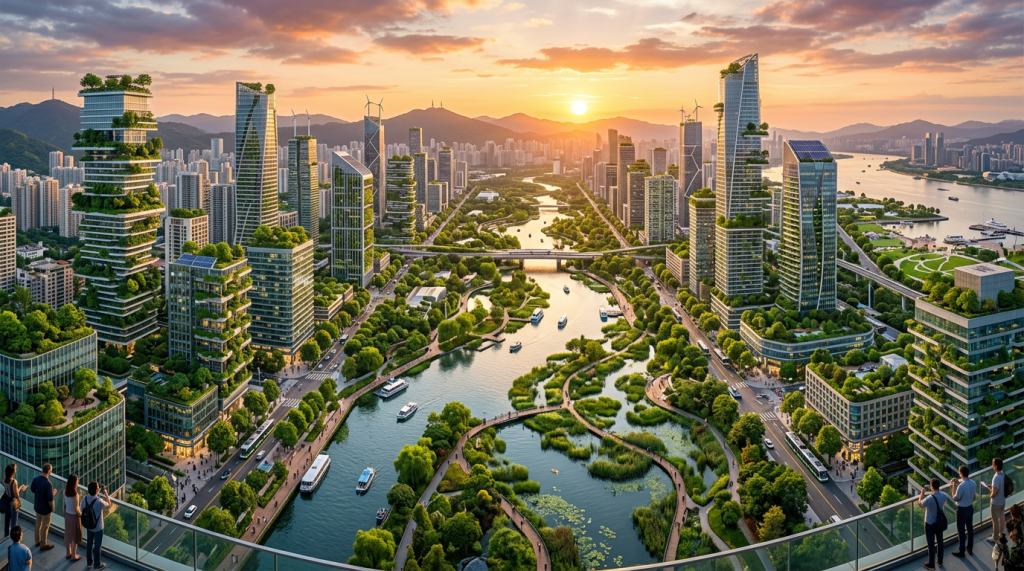
It is crucial to recognize that the debate is not grey vs. green. The future city will not survive as a concrete fortress, but nor will it be an unrestrained jungle. The blueprint for the 21st-century city is integrated, hybrid, blue-green-grey synergies.
The future is “grey enabling green.” This philosophy uses engineered smart systems to maximize the performance of natural ones. For example:
- Blue-green roofs: These combine a green roof (living plants) with a smart detention tank beneath it. Sensors monitor weather forecasts; if a storm is predicted, the tank drains slowly to maximize capacity. During the storm, it detains water for slowly releasing it for later irrigation or evaporation, combining the engineered control of a tank with the ecological benefits of the garden.
- Integrated corridors: Designing a street as a “sponge” requires using permeable pavement to infiltrate water (green), which then drains into an underground gravel storage chamber (grey), which then overflows into a modernized sewer system during extreme 100-year events (grey).
- Living seawalls: In coastal areas facing sea-level rise, the traditional concrete seawall (grey) must be enhanced by integrating constructed reefs or mangrove habitats (green) that absorb wave energy, reduce erosion, and provide aquatic habitat, ensuring the concrete structure lasts longer by reducing the stress it faces.
What this means for the future of cities
The transition from a grey-only model to a grey-green hybrid means a profound shift in how we build, manage, and pay for urban areas. It means:
- A new urban aesthetics: Cities will look different. There will be fewer vast expanses of cracked asphalt and more distributed greenery – rain gardens in parking lots, tree canopies over streets, and vibrant rooftops.
- Resilience beyond flood defence: Cities will be managed for resilience and liveability. We won’t just ask if a neighbourhood is “safe from flooding.” We will ask if it is “cool enough during heatwaves,” “clean enough to breathe,” and “has enough access to nature.”
- Decentralized investment: Funding will shift from massive, centralized wastewater treatment plants to smaller, distributed investments across neighbourhoods – funding 5,000 rain gardens instead of one giant tunnel.
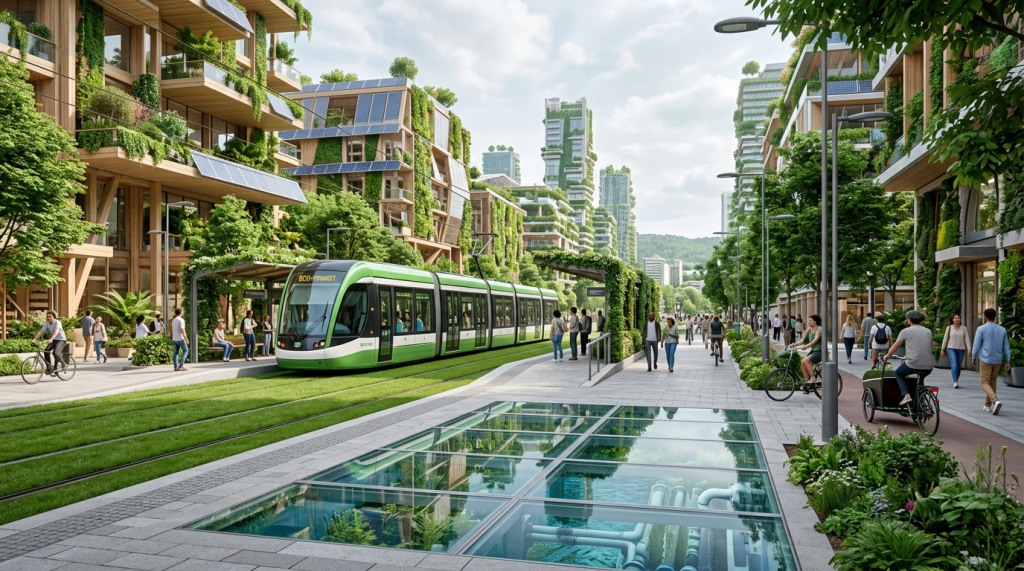
The concrete fortresses of the 20th century were successful in creating the density we take for granted, but they are increasingly vulnerable in an age of climate extremes. The nature of the natural world is adaptive, absorptive, and resilient. To future-proof our urban homes, we must combine the reliable strength of concrete engineering with the living adaptability of ecological systems. We have built our cities to resist nature; the future requires us to build them to become nature – living, vibrant urban sponges.
The future of your city isn’t just shaped by high-level planners; it’s shaped by everyday observations and local policy.
This week, take a walk through your neighborhood. As you do, look at the streets and buildings not as static objects, but as a system managing water and heat.
- Where does the water go when it rains? Is it channeling off an asphalt parking lot directly into a drain, or is it pooling near a thirsty tree pit?
- Do the sidewalks feel like ovens, or are they cooled by a canopy of leaves?
- Identify one place – a vacant lot, a parking median, or even your own driveway – where a patch of concrete could be replaced with a living system.
The change begins when we stop seeing nature as something that belongs outside the city, and start recognizing that it is the single most important technology for our survival within it.
Next week, we are investigating autonomous mobility for the better future for cities!
Ready to build a better tomorrow for our cities? I’d love to hear your thoughts, ideas, or even explore ways we can collaborate. Connect with me at info@fannimelles.com or find me on Twitter/X at @fannimelles – let’s make urban innovation a reality together!
 Vitruvian Solutions
Leave a comment