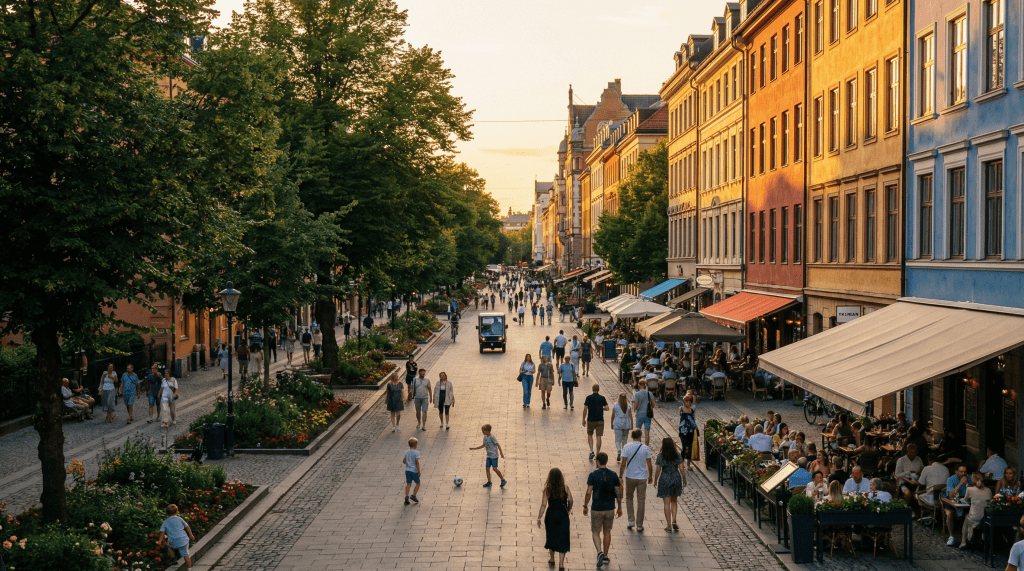
Imagine Maria, a young mother in the Spanish city of Pontevedra, starting her day. She steps out of her apartment, her two children in tow, and walks the short distance to school. No dodging speeding cars, no choking on exhaust fumes – just the sound of laughter and birdsong. The streets, once clogged with traffic, now buzz with pedestrians, cyclists, and the occasional delivery vehicle. This isn’t a dream; it’s the reality of Pontevedra since 1999, when the city drastically reduced car access in its core. Such transformations are part of a global movement towards car-independent urban design, where cities prioritise people over vehicles. This shift addresses the failures of 20th-century auto-centric planning, which sacrificed public space for roads and parking. Today, empirical evidence from cities worldwide shows that reducing car dependency enhances environmental health, boosts community ties, and drives economic growth. As urban populations swell, this model offers a blueprint for resilient, liveable cities.
The environmental imperative: Atmospheric remediation and biosphere regeneration
The most compelling argument for car-independent design lies in its environmental impacts. Private vehicles are major contributors to urban pollution, emitting nitrogen oxides, carbon monoxide, and particulate matter that trap in “urban canyons” formed by tall buildings. In Barcelona’s Superblocks – clusters of nine blocks where internal streets are closed to through-traffic – nitrogen dioxide (NO2) levels dropped by 33% in the Sant Antoni district within a year of implementation. This reduction is vital, as NO2 irritates respiratory systems and contributes to asthma. Similarly, a study estimated that full rollout of Barcelona’s original Superblocks could cut ambient NO2 by 24%, aligning with World Health Organisation guidelines.
Noise pollution, often overlooked, is another stressor. Chronic exposure to traffic noise above 55 decibels elevates cortisol levels, leading to hypertension and sleep issues. In Pontevedra, banning through-traffic and imposing speed limits transformed the acoustic landscape, dropping noise to levels where normal conversations thrive. Picture Alex, a resident in Ghent, Belgium, who once endured constant honking outside his window. After the 2017 Circulation Plan sectorised the city to prevent cross-centre driving, noise fell, and Alex reports better sleep and reduced stress.
Thermal regulation benefits are equally profound. Asphalt absorbs heat, exacerbating urban heat islands. Depaving streets for green corridors, as in Barcelona’s Green Axes plan, could lower temperatures by 1.2°C on hot days. This not only cuts energy use for cooling but enhances biodiversity. Car-free zones allow for more trees and green spaces, creating corridors for pollinators and improving residents’ immune systems through microbiome exposure.

Reclaiming the public realm: Fostering social cohesion and health
Car-dependent designs sever communities, turning streets into barriers. High-traffic roads reduce neighbourly interactions, creating “community severance.” In contrast, car-independent models reclaim space for human connection. In Freiburg’s Vauban district, Germany, car-free living has led to vibrant street life where children play safely and neighbours converse regularly.
Consider Sofia, an elderly resident in Copenhagen. Before expansions of pedestrian spaces, she rarely ventured out due to traffic fears. Now, with over three times more outdoor activities reported in such areas, Sofia enjoys daily walks and chance encounters that combat isolation. Public health gains are substantial. Active mobility – walking and cycling – becomes default, reducing risks of obesity and diabetes. Barcelona’s Superblocks could prevent 36 premature deaths annually from increased physical activity alone. Mental health improves too; green views and quiet streets lower cortisol, potentially saving Barcelona €45 million yearly in mental health costs.
Safety is paramount. Pontevedra has recorded zero fatal traffic accidents since 2011, down from 30 in the prior decade. This “Vision Zero” approach eliminates conflict points between vehicles and vulnerable users. Moreover, pedestrianised streets enhance natural surveillance, reducing crime through “eyes on the street.”
Lior Steinberg described the car-free city as one that provides other options than the necessary use of cars for transportation and mobility in episode 396I on the What is The Future for Cities? Podcast:
Case studies in action: Operational models from Europe
Real-world examples illustrate how cities operationalise this shift. Pontevedra‘s “necessary traffic only” model distinguishes essential vehicles from unnecessary ones, banning through-traffic and eliminating on-street parking. This slashed CO2 emissions by 70% and reduced central traffic from 80,000 to 7,000 vehicles daily. The city gained 12,000 residents, attracting families with its safety.
Ghent‘s Circulation Plan, implemented over one weekend in 2017, divided the centre into sectors, forcing cars to exit via the ring road for inter-sector travel. Cycling mode share rose 25%, car traffic fell 12% on the ring road, and public support grew despite initial backlash.
Barcelona‘s Superblocks and evolving Green Axes transform streets into linear parks. In Sant Antoni, traffic dropped 92%, NO2 by 33%, and noise by 4 dB. The full plan could prevent nearly 700 premature deaths yearly. These cases show tailored strategies yield measurable gains.
Opportunities are also discussed in episode 395R on the What is The Future for Cities? podcast as pathways to healthy urban environments:
Viability
Stimulating retail and municipal savings
Contrary to myths, car-independent designs boost economies. Pedestrians linger, browsing and impulse-buying, increasing “dwell time.” A Spanish study using banking data found pedestrianised streets record higher retail sales, especially for cafés and local shops. In Ghent, post-Circulation Plan, new businesses in hospitality surged 20%, with fewer bankruptcies.
Real estate appreciates; Barcelona’s Green Axes raised nearby rents by 15%. However, this risks “green gentrification,” necessitating rent controls. Municipally, savings accrue from reduced road maintenance – bikes cause negligible wear compared to vehicles. Barcelona’s Superblocks generate €1.7 billion annually in health savings. Residents save too; ditching cars frees up thousands yearly for local spending.
Ensuring functionality without cars
Cities must maintain operations like deliveries and emergencies. Urban consolidation centres (UCCs) on peripheries transship goods to zero-emission vehicles, with micro-hubs for final legs. Cargo bikes handle up to 25% of deliveries, faster in dense cores. In Vienna and Prague, they facilitate food and parcels efficiently.
Emergency access improves; car-free zones use retractable bollards, and empty lanes speed ambulances. In Culdesac Tempe, USA, promenades double as fire lanes. Regulated delivery windows, as in Pontevedra, ensure commerce without chaos.
Navigating the transition
Implementation faces hurdles. Public acceptance follows a “J-curve” – initial resistance gives way to support post-benefits. In Pontevedra, the mayor has been re-elected since 1999. Ghent‘s swift rollout minimised dilution.
Accessibility for disabled persons requires exemptions, like blue badge access. Equity demands inclusive planning to avoid displacing low-income groups. Governance gaps exist; real-world policy must address unintended consequences for car-dependent residents.
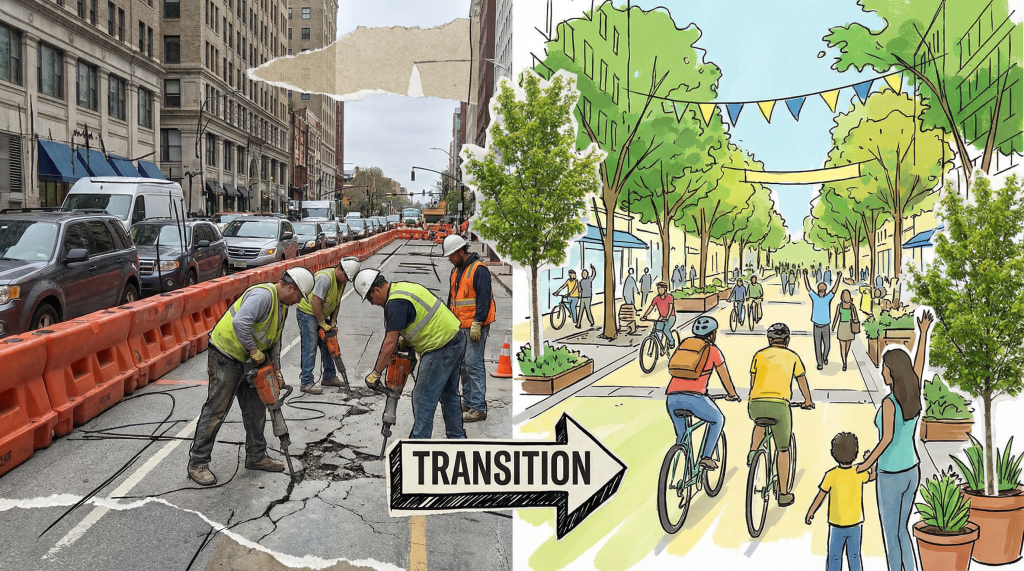
The evidence is clear: car-independent urban design delivers superior outcomes across metrics. From Pontevedra’s zero fatalities to Barcelona’s health savings, these models prove operational and replicable. As Maria, Alex, and Sofia show, this isn’t subtraction – it’s adding life back to cities. By viewing urban spaces as habitats for humans, not machines, we foster resilient, equitable futures.
The transition demands bold action, but the rewards – cleaner air, stronger communities, thriving economies – are profound.
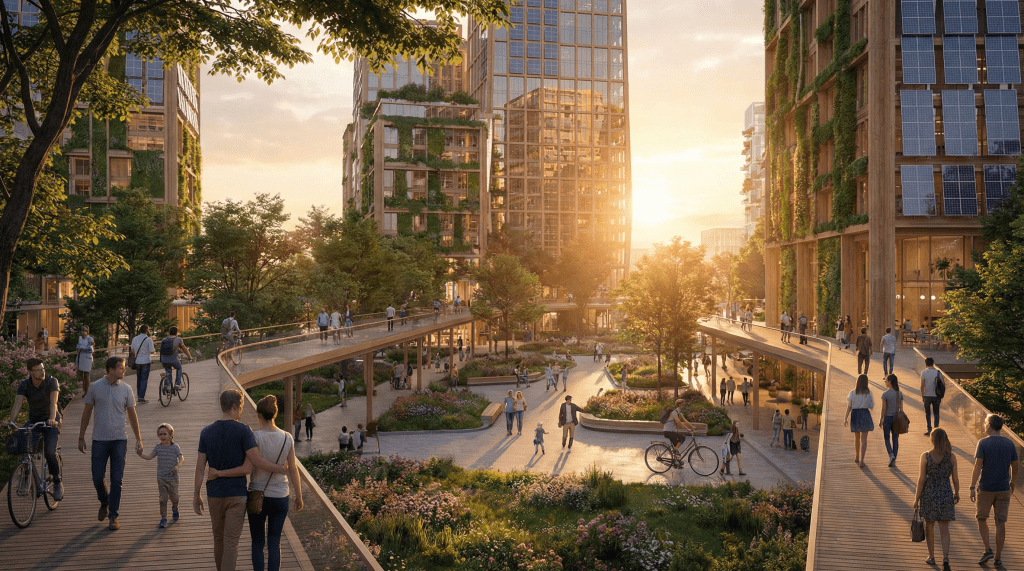
Next week, we are investigating entrepreneurial capitalism as crucial part of the future of cities!
Ready to build a better tomorrow for our cities? I’d love to hear your thoughts, ideas, or even explore ways we can collaborate. Connect with me at info@fannimelles.com or find me on Twitter/X at @fannimelles – let’s make urban innovation a reality together!
 Vitruvian Solutions
Leave a comment