The modern city is a paradox. It is where human potential aggregates, yet the systems that govern our urban lives are increasingly fractured. For the last decade, we were promised “Smart Cities” – a glittering future of optimised traffic flows and seamless connectivity delivered by technology giants. While these initiatives gave us better sensors and data dashboards, they often left citizens feeling like passive users rather than active participants.
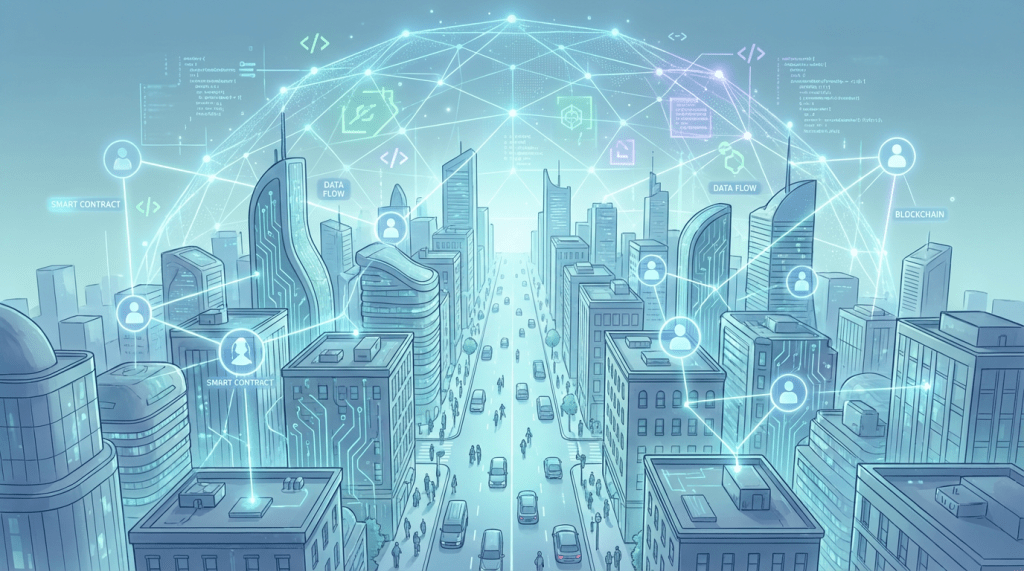
But while city planners were signing contracts with legacy vendors, a quiet revolution was brewing on the internet. It wasn’t happening in parliament, but in Discord servers and GitHub repositories. The Decentralized Autonomous Organization (DAO) – an internet-native collective governed by code and smart contracts – has evolved from a niche crypto experiment into a viable model for coordinating human activity at scale.
Could this technology be the missing layer in our urban operating system? To answer this, we must look at the data, the hurdles we face, and the immense opportunities that lie ahead.

The “Bahn Mi” problem: Why we need a new OS
To understand why our current urban models need an upgrade, we do not need to look at complex algorithms; we just need to look at a sandwich shop.
Research from RMIT University into the “Digital CBD” highlights a critical breakdown in the post-COVID economy. Imagine a small Bahn Mi shop at the base of a corporate tower in Melbourne. Before 2020, foot traffic was a tidal force; the owner knew exactly how many rolls to bake. Today, with hybrid work, an audit team from a major firm like Deloitte might only inhabit the building on Thursdays. The shop owner, lacking real-time data, is flying blind – either understocking and losing revenue, or overstocking and creating waste.
This is not just a sandwich problem; it is a coordination failure. In the traditional model, data is locked in proprietary dashboards owned by vendors or the city, inaccessible to the people who power the economy. A DAO-based “Data Trust” could flip this script, allowing tenants, landlords, and shop owners to pool anonymized occupancy data. This would create a “management commons” where the sandwich shop owner knows exactly when the auditors are coming, optimising resources and reducing waste.

The hurdles: Growing pains of a new technology
Before we get carried away with the utopian potential of DAOs, we must address the elephant in the room. This technology is still in its adolescence, and integrating it into the messy reality of physical cities comes with significant challenges.
The legal grey area
A DAO is, fundamentally, software. But software cannot easily sign a lease or hire a street cleaner. The legal interface between code and the real world is fraught with complexity. In the United States, states like Wyoming have pioneered “DAO LLC” laws to give these entities legal standing, but in Europe and the UK, the regulatory framework remains fragmented. Without a clear “legal wrapper,” DAO members can technically be held personally liable for the organisation’s actions, a risk profile that scares away many potential civic participants.
The “plutocracy” risk
Most early DAOs operate on a “one token, one vote” basis. In a corporate setting, this makes sense – shareholders with more skin in the game get more say. In a civic setting, however, it is disastrous. It effectively allows a wealthy developer to buy 51% of the governance tokens and vote to rezone a park into condominiums. For DAOs to work in cities, they must solve the “identity” problem, ensuring that governance is based on personhood (one person, one vote) rather than wealth. Early experiments have struggled with this, with data showing that in many major DAOs, less than 1% of holders control 90% of the voting power.
The challenge of engagement
We often assume that if we give people the power to vote, they will use it. The data suggests otherwise. Municipal election turnout is already notoriously low – often hovering between 15% and 25% in major US cities. Early DAO governance has faced similar apathy, with participation rates in some major protocols sitting around 17% to 28%. If we simply move bureaucratic boredom onto a blockchain without improving the user experience, we have solved nothing.
This tension between the technological promise of smart city governance and the reality of social exclusion is debated further in episode 379R on the What is The Future for Cities? podcast:
The opportunities
Despite these hurdles, the potential for DAOs to revolutionise how we build and maintain our cities is undeniable.
Infrastructure that builds itself
The most exciting development is DePIN (Decentralized Physical Infrastructure Networks). This model flips the script on how public utilities are funded and built. Traditionally, building a telecom network requires a massive company to spend billions on towers. DePIN protocols incentivise everyday citizens to host the hardware themselves in exchange for tokens.
Helium proved this model works by convincing everyday people to install LoRaWAN hotspots in their windows. In just a few years, they deployed nearly a million hotspots globally, creating a ubiquitous IoT network faster and cheaper than any traditional telco could manage. Cities are now using this network to track everything from e-scooters to air quality sensors without having to build the infrastructure themselves.
Another standout example is Hivemapper. While Google Street View cars might visit a neighbourhood once every two years, Hivemapper incentivises delivery drivers and commuters to install 4K dashcams. These drivers earn HONEY tokens for mapping the roads as they drive. The result is a map that updates in near real-time. For a city council, this is a superpower: they can spot potholes, zoning violations, or damaged signage weeks before a municipal inspector would typically file a report.
Smarter governance and budgeting
If DePIN handles the hardware, how do we handle the software of democracy? DAOs are experimenting with decision-making tools that are far more sophisticated than the binary “yes/no” votes we use in politics.
In a standard vote, you cannot express how much you care about an issue. A resident indifferent to a new playground has the same voting power as a parent who relies on it daily. Quadratic Voting (QV) changes the math. It gives voters a budget of “voice credits.” You can cast multiple votes for an issue you care deeply about, but the cost increases quadratically (1 vote costs 1 credit, but 2 votes cost 4 credits). This aligns with the ‘Crypto Cities’ vision proposed by Vitalik Buterin, who advocates for using blockchains to experiment with new forms of democratic governance—a concept summarised in episode 022R of the What is The Future for Cities? podcast.
This isn’t just theory. The Colorado State House of Representatives successfully used a QV interface to prioritise their budget. Faced with over 100 proposed bills and a limited $40 million budget, legislators used QV to identify “consensus priorities” – items that had broad, deep support across the caucus, rather than just pet projects of the loudest members.
Cities like Paris and Brno (Czechia) are already proving that citizens want a direct say in how money is spent. In Brno, the “Dáme na vás” (It’s up to you) programme allows residents to propose and vote on projects ranging from park revitalisations to environmental education centres, with the city allocating millions of euros to the winners . Paris has run one of the world’s largest participatory budgets, funding bicycle lanes and urban agriculture .
Moving this process to a DAO structure adds a layer of radical transparency. Instead of a black-box municipal budget, imagine a “City DAO Treasury” where every dollar spent is trackable on-chain. Residents wouldn’t just vote once a year; they could see the funds moving in real-time as milestones are met.
A radical extension of this logic is investigated more in detail in episode 370 of the What is The Future for Cities? podcast, where Liberland President Vít Jedlička outlines his vision for a ‘shareholder state’ that replaces mandatory taxes with voluntary, merit-earning contributions:
Energy sovereignty
As our cities electrify, our power grids are struggling. They were designed for a one-way flow of energy – from a massive power plant to your home. They were not designed for a world where every home has solar panels and an electric vehicle.
The Brooklyn Microgrid offers a glimpse of the DAO-enabled future. It created a “Transactive Grid” in New York where neighbours can trade energy peer-to-peer. If you are away on holiday and your solar panels are generating excess power, you don’t just sell it back to the utility for pennies. Through a blockchain-based platform, you can sell it directly to your neighbour (or a local school) who needs it.
This creates local resilience. In the event of a major blackout – increasingly common with extreme weather events – these microgrids can technically “island” themselves, keeping the lights on in the neighbourhood even when the main grid fails.
Regenerative finance (ReFi)
Perhaps the most profound shift DAOs offer is economic. Our current economy is extractive; money spent at a local chain store often leaves the community immediately. Regenerative Finance (ReFi) uses tokenomics to trap and multiply value locally.
Funding public goods Gitcoin has pioneered a mechanism called “Quadratic Funding” to support digital public goods. It matches individual donations with a larger pool of funds, but the matching formula favours projects with many small donors over those with a few wealthy ones. This ensures that funding goes to projects the community actually values.
The Optimism Collective takes this a step further with “Retroactive Public Goods Funding” (RetroPGF). Instead of trying to guess which projects will be successful (the grant model), they wait to see what has been useful and then reward the creators retroactively. In their recent rounds, they have distributed millions of dollars to developers and educators who built critical infrastructure, creating a powerful market incentive to do good work without needing permission first.
In Curaçao, the Kolektivo framework is experimenting with a local currency backed by ecological assets. They tokenise natural capital – like food forests – and use a community currency to circulate value. When the local environment improves, the economy strengthens. This creates a feedback loop where economic activity directly funds environmental restoration, rather than degrading it.

Democratising ownership
Finally, DAOs can help us take back ownership of the city itself. Real estate is the world’s largest asset class, yet it is increasingly out of reach for the people who live in our cities.
Platforms like Lofty and RealT allow fractional ownership and are using DAOs to tokenize real estate. By splitting a rental property into tokens on a blockchain, they allow residents to own a fraction of a property for as little as $50. Lofty has already tokenized over 140 properties, allowing users to earn rental income daily. While we must be careful not to hyper-financialise housing, this technology offers a path for tenants to build equity in the buildings they inhabit.
We are also seeing the rise of “Housing DAOs” – a.k.a housing as a commons – that function like digital cooperatives. Projects like the Breadchain Cooperative are using DeFi (Decentralized Finance) protocols to act as a credit union, lowering the cost of capital for housing co-ops. This merges the old-school stability of the cooperative model with the speed and global liquidity of crypto finance.
Adam Miller (MIDAO) explores this hyper-local potential in episode 380 of the What is The Future for Cities? podcast, arguing that the biggest opportunity lies in ‘going smaller’—using DAOs to upgrade Homeowners Associations (HOAs) and giving residents direct control over their local parks and shared spaces:
The hybrid city
So, is the DAO the future of the city? The answer is yes, but likely not in the way the “crypto-secessionists” imagine. We are unlikely to see nation-states replaced by Discord servers anytime soon.
Instead, the future is hybrid. It is a future where the rigid, reliable machinery of the state is augmented by the agile, transparent coordination layers of the DAO.
We are moving towards a world where:
- Business Improvement Districts run as DAOs, using quadratic voting to decide whether to fund a new festival or better security.
- Infrastructure is crowdsourced via DePIN, with the city acting as a customer rather than a builder.
- Disaster relief happens at the speed of the internet, as seen with the Unchain Fund in Ukraine, which raised and deployed millions in crypto aid while traditional NGOs were still filling out paperwork.
- Community assets, from parks to pubs, are co-owned by residents through tokenised structures.
The “Smart City” was about installing sensors. The “Networked City” is about empowering citizens. By leveraging DAOs, we have the chance to build cities that are not just efficient, but genuinely cooperative, resilient, and owned by the people who call them home. The technology is ready; the next step is up to us.
Next week, we are investigating the opportunities and challenges of learning from past examples for better urban futures and mixed communities, with Carolyn Whitzman!
Ready to build a better tomorrow for our cities? I’d love to hear your thoughts, ideas, or even explore ways we can collaborate. Connect with me at info@fannimelles.com or find me on Twitter/X at @fannimelles – let’s make urban innovation a reality together!
 Vitruvian Solutions
Leave a comment