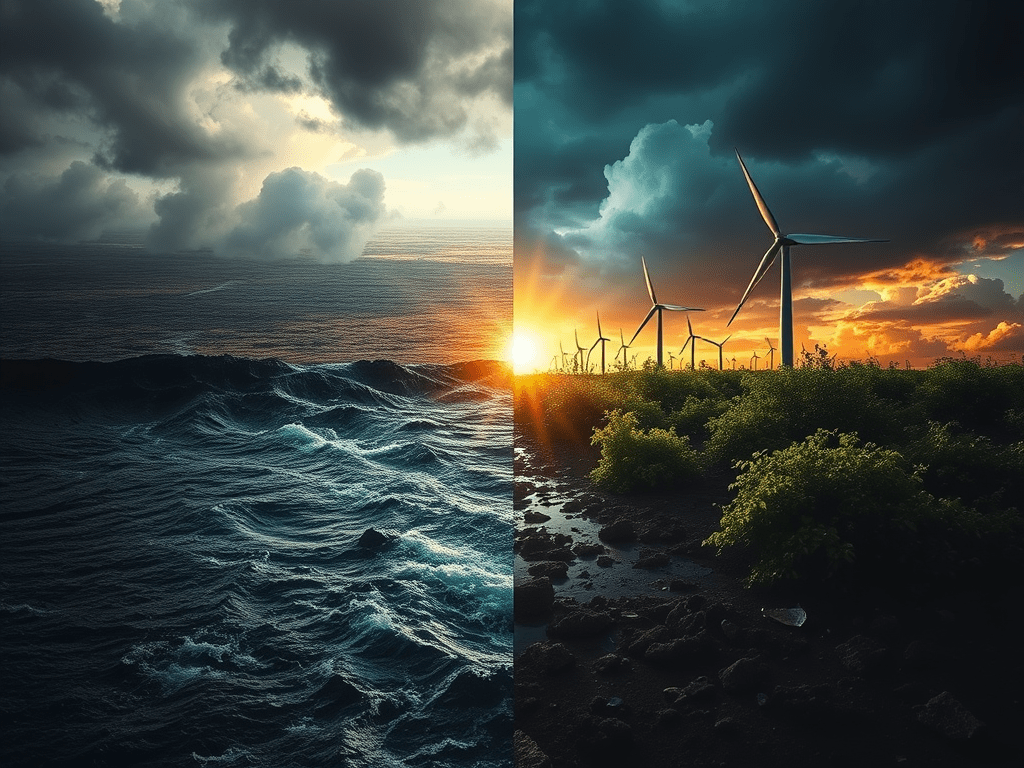
When you think about climate change, what comes to mind? Is it fear, despair, or the overwhelming sense that the problem is too large to tackle? This reaction is common—and understandable. The latest predictions and projections paint a dire picture of our planet’s future. However, is fear really the best motivator to address climate change? Or could it be holding us back?
Fear as a double-edged sword
Fear can be a powerful motivator, but it can also paralyze. In my experience, when people learn about climate models and the Intergovernmental Panel on Climate Change (IPCC) projections, they often respond with resignation: “It’s too late; we can’t solve climate change.” This mindset is destructive, disheartening, and dangerous. While fear has its place in highlighting the urgency of the crisis, it must be balanced with hope and actionable solutions.
As David Deutsch famously said: “Problems are inevitable, but problems are soluble.” (Beginning of Infinity by David Deutsch) Climate change is undoubtedly a monumental challenge, but it is not insurmountable. We already possess the technologies, scientific knowledge, and policy frameworks to shift the trajectory toward a brighter future. The question is: how do we inspire action without overwhelming people with despair?
(I will not use sustainability in this post because I am not totally on board with the concept – check out this post if that is alarming!)

The IPCC: A Source of Truth and Alarm
The IPCC has been instrumental in communicating the science of climate change. Established in 1988, it synthesizes research to provide policymakers with clear insights into the risks and solutions. The latest reports confirm rapid warming, rising sea levels, and extreme weather patterns, all demanding immediate action. However, these projections often rely on linear models, overlooking the exponential potential of emerging technologies.
This is where the narrative needs to evolve. The IPCC emphasizes the consequences of inaction, but what about the opportunities in action? Framing climate change as an opportunity for technological and societal innovation could shift perceptions from despair to determination. As Adam Dorr explains in his book, Brighter – Optimism, Progress and the Future of Environmentalism, the communication of current trajectories and situations are important but the predictions do not include the technological progress – basically human evolution – thus making false and despairing predictions (178R – book summary on the What is The Future for Cities? podcast).
COP: collaboration or stalemate?
The annual COP meetings, such as COP29 in Baku, aim to foster global collaboration on climate change. While these gatherings have achieved significant milestones, such as the Paris Agreement and the recent establishment of a Loss and Damage Fund, they are often criticized for being more talk than action. Younger generations (a crucial part for the future of cities as described in this blog post), in particular, have grown disillusioned with the lack of tangible progress.
That said, COP29 did spotlight critical issues like climate finance and private sector engagement. These are essential steps, but they need to translate into measurable outcomes. Real progress requires not only commitments but also enforcement mechanisms and widespread implementation.

We’re Not Going Back: Redefining Responsibility for Change
Let’s address a common narrative in the climate conversation: the push for individuals to consume less, travel less, or live with less. While personal responsibility matters, it’s not the silver bullet for solving climate change. Asking people to reduce their comfort or quality of life often feels counterproductive—it pits environmentalism against human nature and aspirations. History shows that once humans gain comfort and convenience, they rarely relinquish it willingly.
More importantly, this approach misplaces the burden. Demanding less consumption from individuals serves as an easy “get-out-of-jail-free” card for businesses and governments to avoid systemic change. Instead, the responsibility should shift to producers and industries, which have the greatest influence on the systems driving emissions and waste. Harry Robertson describes the different versions of economies and the responsibilities in episode 242 of the What is The Future for Cities? podcast.
Here’s where the circular economy and emerging technologies come into play:
- Circularity: Producers can design products for reuse, repair, and recycling. For example, companies like Patagonia are leading the way by encouraging customers to repair their gear instead of discarding it. Circularity shifts the focus from “less consumption” to “better design and reuse.”
- Sharing Economy: Platforms like car-sharing services and second-hand marketplaces make resource use more efficient, reducing waste while maintaining consumer convenience.
- Emerging Technologies: Innovations in materials science, energy efficiency, and production methods can reduce emissions, energy use, and waste across entire industries. For instance, 3D printing is enabling on-demand production, reducing overproduction and transportation costs.
The future isn’t about asking individuals to sacrifice even though we do have individual responsibility to create the better future we want—it’s about creating systems which are better for everyone. This means businesses and governments must take the lead, using regulation, innovation, and market incentives to drive change. As Prof Marcus Foth described in episode 256 (What is The Future for Cities? podcast) we have the technology to solve climate change, science already has the solutions and the proof, the next is to implement these on a wider scale to stop the current trajectories.
Technologies Leading the Way
One of the most promising aspects of the climate conversation is the emergence of disruptive technologies. Organisations like RethinkX have demonstrated that innovation isn’t just about environmental responsibility—it’s about economic opportunity. Their research on disruptive technologies (based on the Seba Technology Disruption Framework) shows that cleaner, more efficient technologies are often cheaper than traditional ones. This means that change is not only necessary but also financially compelling.
Take these examples, as Adam Dorr, Director of Research at RethinkX, explained in episode 222 on the WTF4Cities? podcast:
- Energy: Renewable energy sources like solar and wind are now among the most affordable forms of electricity. Advances in energy storage, such as battery technology, make them more reliable and scalable. This transition reduces emissions and creates jobs in green industries. (Though we could also include nuclear, but let’s not go there today…)
- Transport: Electric vehicles (EVs) are revolutionising how we move. Not only are EVs cleaner, but they are also cheaper to maintain and increasingly affordable to purchase. Autonomous vehicles and public transport innovations promise to make cities more accessible, safer, and adaptable.
- Food: Alternative proteins, such as lab-grown meat (like Magic Valley‘s cultivated meat product, described by Paul Bevan, CEO, on the 238th WTF4Cities episode) plant-based substitutes, and agricultural innovation (like vertical farming, aquaponics, and the like, as described by Matt Ferrell in episode 120 on the podcast) are transforming how we produce our food. These innovations use fewer resources and produce significantly lower emissions while meeting global demand for food.
- Labour: Automation and artificial intelligence (AI) are enabling smarter, more efficient systems across industries, reducing waste and optimising resource use.
These technologies show that environmentally friendly solutions and profitability are not mutually exclusive. They are the foundation of a brighter, more equitable future.
Urban Experimentation: Building the Future in Cities
We are at the cusp of tremendous societal changes, as Richard Gill, CEO of RethinkX, expressed on the What is The Future for Cities podcast 274th episode. Cities are uniquely positioned to lead the charge. They are where most of the world’s population lives and where the impacts of climate change are most acutely felt. At the same time, they are hubs of innovation, creativity, and resilience.
Urban experimentation—trying new ideas in real-world settings—is essential to finding scalable solutions. Pilot projects in areas such as energy-efficient housing, green infrastructure, and circular economies are already proving that change is possible. These efforts not only reduce emissions but also improve the quality of life for residents.
A North Star for Transformation
Change is never linear. There will be missteps, delays, and detours. But within this messy process lies progress. Having a clear vision—a “North Star”—is essential to guide efforts and maintain momentum. This vision should inspire optimism while acknowledging the challenges ahead.
Consider this: the same creativity and determination that have brought us breakthroughs in medicine, space exploration, and technology can be directed toward solving climate change. The difference is that this time, the stakes involve the very future of our planet.
The Power of Hopeful Narratives
What if we reframed the climate conversation? Instead of focusing on catastrophic predictions, we could emphasise the opportunities for innovation, collaboration, and prosperity. Imagine a world where:
- Clean energy powers our homes and industries.
- Cities are lush, green, and designed for people, not cars.
- Food systems are resourceful, feeding the planet without depleting it.
- Global communities work together to address shared challenges, fostering unity instead of division.
This isn’t a utopian fantasy—it’s a tangible future that we have the tools to build. The choice is ours.
Let’s Build the Future Together
Fear may get people’s attention, but hope is what sustains action. Let’s shift the narrative toward solutions, focusing on what’s possible and how each of us can contribute. Here are some questions to consider:
- How can cities better showcase the positive outcomes of urban experimentation?
- What role can disruptive technologies play in accelerating climate action in your community?
- How can we ensure that climate solutions are accessible and equitable for everyone?
The future is not something that happens to us—it’s something we create. Let’s commit to shaping it together.
Which of these ideas inspires you most? How will you contribute to this transformation? Let’s discuss—because the future depends on it.
 Vitruvian Solutions
Leave a comment