Urban mobility is changing rapidly as cities worldwide manage growing populations, congestion, and the demand for efficient transport. By 2025, more than half the world’s population resides in cities, straining existing systems to evolve. This article examines the trends, technologies, and obstacles influencing how people will travel in urban environments in the years ahead. From autonomous vehicles to shared rides and aerial options, innovations aim to make journeys faster, more convenient, and integrated. Based on recent studies and projections, we’ll cover historical context, emerging technologies, their connection to public systems, challenges, and a visionary glimpse into a transformed future.
This transformation is about reimagining city operations. With artificial intelligence and data tools, transport can optimise routes, reduce delays, and lessen dependence on personal cars. However, questions of safety, infrastructure, and regulation arise. Balancing progress with real-world application will be essential for functional urban spaces.

History of urban mobility
Before the automobile, urban transport relied heavily on horses. In the 19th century, horses powered streetcars, carriages, and wagons in cities, facilitating movement of goods and people. Horse-drawn vehicles were integral to daily life, with streetcars on rails becoming common in urban areas by the late 1800s, transporting large numbers efficiently. However, this era brought issues like waste (and horse manure…) accumulation and limited speed, as cities struggled with the volume of horses needed for growing populations.
The introduction of the automobile marked a significant innovation. In the early 20th century, cars offered a cleaner, faster alternative to horses, addressing the waste and inefficiency problems of equine transport. The internal combustion engine enabled quicker travel and greater flexibility, revolutionising urban mobility. Roads transitioned from accommodating horses to supporting vehicles, with automobiles rapidly replacing horse-drawn carriages – by 1912, cars outnumbered horses in some cities. This shift was not without resistance, but the benefits in speed and capacity made it a practical solution for the mobility demands of the time.
As societies evolve, new challenges emerge from past solutions. The combustion engine car, while groundbreaking at the time, now contributes to congestion and requires vast infrastructure. With expanding knowledge and technology, better alternatives arise. Among others, electric and autonomous systems build on this history, offering refined approaches to urban travel. This progression reflects how innovations solve prior issues while introducing new ones, leading to continual advancement in mobility.
The “Carriage Era” from the late 17th to early 20th century highlighted the role of horse-drawn vehicles in urban expansion, but the automobile’s arrival accelerated change. Today, we can apply modern tools like AI and connectivity to address current limitations, paving the way for more efficient systems.

Emerging technologies in urban mobility
Numerous technologies are poised to reshape city travel. Autonomous individual vehicles stand out, using sensors, AI, and machine learning to navigate without human intervention, potentially reducing human errors and optimising routes. These self-driving cars could transform personal transport, allowing passengers to use travel time productively, such as working or relaxing during commutes. Trials indicate they handle urban complexity better over time, with advancements in AI enabling better decision-making in dynamic environments like busy intersections or construction zones. A critical aspect is vehicle-to-vehicle (V2V) communication, where autonomous cars exchange real-time data on speed, position, and intentions. This connectivity allows vehicles to coordinate movements, smoothing traffic flow and potentially eliminating congestion by preventing sudden stops or inefficient spacing. Studies show that even a small percentage of connected autonomous vehicles can reduce stop-and-go waves – those accordion-like patterns where traffic bunches and releases without apparent cause – by up to 35%, leading to more consistent speeds and shorter travel times. In 2025, advancements in 5G and AI are accelerating V2V and vehicle-to-infrastructure (V2I) integration, enabling real-time responses to traffic conditions and further reducing jams. Regulations remain key to widespread use, with updates like NHTSA’s 2025 framework addressing safety and incident reporting.
One of the best description of traffic snakes and how autonomous vehicles will help with that is from CGP Grey on Youtube:
Autonomous public transport extends this to larger scales, with driverless buses and shuttles on fixed or flexible routes enhancing frequency and lowering operational costs by eliminating driver salaries and enabling 24/7 service. European tests show improved reliability in city corridors, with systems adapting to passenger demand in real-time. In 2025, the global autonomous bus market is expected to reach $2.5 billion, growing at 20% CAGR, driven by pilots in cities like Singapore and companies like Imagry aiming for full deployment by late 2025. These vehicles incorporate advanced sensors and AI for safe navigation, with potential expansions to autonomous trucks and robotaxis by 2035. Challenges like public trust are being addressed through controlled trials, paving the way for broader adoption in urban transit.
Public transport itself evolves with smart systems, incorporating real-time tracking, predictive analytics, and AI for better scheduling and route optimisation. In 2025, priorities include real-time monitoring (43% of organisations), mobile payments (42%), and AI applications for operations like predictive maintenance and demand forecasting. Smart traffic lights and real-time bus/train tracking adjust to patterns, reducing delays and improving efficiency. These systems unify modes like buses and trains, enabling seamless transfers and using data analytics for smarter urban planning.
Sarah Bridges, in episode 326 of the What is The Future for Cities? podcast, emphasizes the role of public transport investments in fostering connectivity and enabling seamless, AI-optimized multimodal urban travel:
Shared rides, via apps like ride-hailing pools, promote efficient use of vehicles by matching passengers with similar paths, reducing the number of cars needed and easing congestion. Combining sharing with autonomy could create on-demand fleets that adapt to demand dynamically. Ride-hailing is eradicating in upcoming generations the will or need for owning a car or a driver’s licence, as convenience and cost-effectiveness make personal vehicles less appealing. Studies show younger generations like Gen Z are getting licences at lower rates, opting for apps like Uber instead, with examples like Uber’s CEO noting his son hasn’t obtained one due to rideshare availability. This shift reduces vehicle ownership, particularly among millennials and Gen Z, influenced by high costs of cars, insurance, and maintenance.
Active transport, including walking and cycling, gains support through tech like smart paths and apps for route planning. Micromobility devices such as e-bikes and e-scooters enhance this for short distances, with rental apps and docking stations facilitating access. Dedicated infrastructure ensures safe integration, with trends showing a 47% surge in e-bike trips in 2025. Advancements include better battery life, affordability, and integration with public transport for first/last-mile solutions, with the micromobility market expected to reach $15.17 billion by 2034. Policies are adapting to new devices like e-motos, ensuring standards for safety and urban compatibility.
3D mobility introduces aerial options like drones and electric vertical take-off and landing (eVTOL) vehicles, or flying cars. These could bypass ground traffic for quicker trips, with prototypes targeting commercial use by the late 2020s. Vertiports and air traffic management are developing to support this, with the eVTOL market projected to grow from $264.5 billion in 2025 to $6.56 trillion by 2034 at 42.9% CAGR. Companies like EHang and Archer are revealing aircraft for air taxis, medical transport, and logistics, with ranges up to 80 km and speeds of 120 km/h. Urban air mobility (UAM) leverages AI and IoT for safe operations in smart cities.
In episode 346 of the What is The Future for Cities? podcast, Mina Sartipi explores how AI and IoT-driven technologies, like urban air mobility, can create safer and more efficient smart city transport systems:
Electric vehicles underpin many of these, with battery improvements, faster charging, and expanding networks enabling broader adoption. Shared electric fleets in ride services lower barriers to entry. In 2025, global passenger EV sales are expected to grow 25%, with advancements reducing range anxiety and supporting autonomous integration. Infrastructure growth and policy support are accelerating fleet transitions, with EVs projected to dominate urban mobility by 2030.
These elements interconnect; for example, autonomous eVTOLs could offer hybrid air-ground journeys. Mobility as a service (MaaS) apps unify options, simplifying planning with integrated booking and payments. New mobility must connect with established systems like buses and trains for maximum effect. Micromobility addresses the last-mile gap, linking users to transit hubs via e-scooters or bikes. Cities add lanes and parks near stations to boost this. Studies note increased transit usage when combined. Shared rides feed into high-capacity lines, serving low-demand areas efficiently. MaaS platforms bundle fares for seamless multi-modal trips. Autonomous vehicles upgrade public fleets, with driverless shuttles improving service. Electric buses reduce costs further. For 3D mobility, vertiports at stations could merge air and ground travel. NASA’s air management aids safety. Data sharing between operators and agencies enables real-time apps for better planning. Open data policies foster this. Technologies like 5G and IoT enhance connectivity. AI optimises routes across modes.
Andrew J Cary discusses innovative transportation solutions like electric and shared mobility in episode 354 of the What is The Future for Cities? podcast, highlighting their potential to enhance public transport integration and reduce urban congestion:
Challenges and solutions
Urban mobility faces ongoing issues. Congestion persists with population growth, overwhelming roads and transit. Aging infrastructure, such as old bridges and tracks, demands upgrades. For autonomous vehicles, technical hurdles include reliable perception in adverse weather, complex urban scenarios, and cybersecurity risks where hackers could disrupt fleets. Shared rides bring data privacy concerns and potential over-reliance on apps, excluding those without access. 3D mobility like eVTOLs faces airspace congestion, noise pollution, and high initial costs for vertiports.
Safety concerns arise with new tech; autonomous vehicles need to prove dependable in traffic, while micromobility risks pedestrian conflicts. Regulatory hurdles delay implementation, including licensing, liability in accidents, and international standards for cross-border operations. Space competition for lanes, parking, and charging adds complexity, especially in dense cities where urban form influences performance. Uncertainties in tech adoption slow progress, with debates on whether private or shared AVs dominate, potentially worsening congestion if not pooled. Job displacement in driving sectors and integration with existing transit pose societal shifts.
Solutions include AI for traffic prediction, reducing delays. Partnerships fund infrastructure, with public-private collaborations building smart grids and vertiports. Phased autonomous rollouts build trust, starting in controlled zones before full urban deployment. Modelling anticipates impacts, using simulations to test urban form adaptations. Standards for eVTOL ensure compatibility, with global frameworks addressing airspace. Policies promoting shared AVs over private ones could maximise benefits, like reducing vehicle numbers through incentives. Workforce training programs prepare for new roles in tech maintenance and oversight. Advanced encryption and redundant systems counter cyber threats. Collaboration among stakeholders creates robust systems, ensuring innovations align with city needs.
Episode 353 of the What is The Future for Cities? podcast examines urban mobility scenarios up to the 2030s, providing insights into the challenges of adopting autonomous and shared vehicles to mitigate congestion risks:
A mindblowing futuristic vision
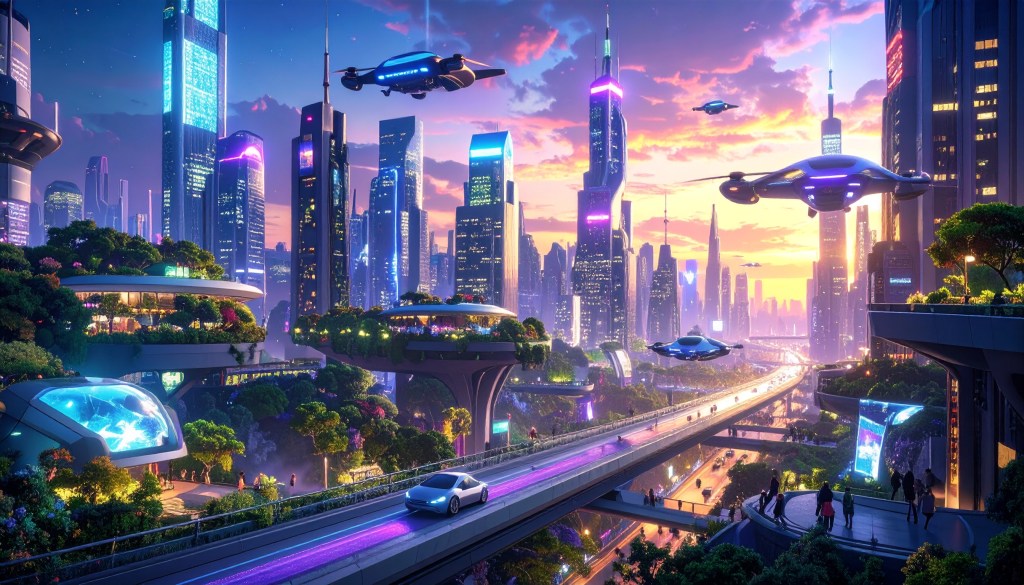
Picture this: it’s a crisp morning in 2050, and you wake in a home that’s more than walls – it’s a node in a vast, energy-abundant network where fusion reactors hum silently, providing limitless power to every corner of the city. No more grids straining under demand; electricity flows like air, fuelling hyperloops that whisk you underground at speeds blurring the landscape, or personal pods that glide on magnetic rails, summoned by a thought via neural implants. Jobs? Most are automated, with AI handling the grind, leaving humans to pursue passions from anywhere – a virtual meeting in a holographic office while your body lounges in a park reclaimed from old parking lots. Rush hours are relics; remote work has dissolved them, turning streets into vibrant spaces for strolling or cycling on adaptive paths that shift with pedestrian flow.
Step outside, and the sky buzzes with eVTOL swarms, silent drones ferrying goods or people across rooftops, their routes orchestrated by quantum AI that predicts your needs before you voice them. Cities sprawl vertically, with green towers linked by aerial bridges, where mobility isn’t just transport – it’s augmentation, with exosuits boosting your stride or augmented reality overlays guiding seamless blends of walking, flying, and teleport-like jumps via wormhole-inspired tunnels. Distance fades; a friend across town feels next door, as telepresence robots let you “be” there without moving, or shared minds in collective vehicles dissolve individuality into group journeys. Energy abundance powers it all, from self-repairing roads to fleets of autonomous vessels on rivers, turning urban chaos into a symphony of efficiency. In this world, mobility liberates, weaving technology into the fabric of life, where every move is effortless, every destination instant, and the city pulses with human potential unchained from the old tethers of time and space.
Urban mobility’s future promises integration of tech for navigable cities. Embracing autonomy, sharing, active modes, and 3D options with public systems tackles congestion.
Challenges require action, but forward visions show feasibility.
As we progress, efficient designs benefit urban life.
Next week, we will explore the holistic resource management!
Ready to build a better tomorrow for our cities? I’d love to hear your thoughts, ideas, or even explore ways we can collaborate. Connect with me at info@fannimelles.com or find me on Twitter/X at @fannimelles – let’s make urban innovation a reality together!
 Vitruvian Solutions
Leave a comment