
Can we truly solve climate change by merely cutting down on emissions? It’s a question worth pondering as the net-zero goal continues to dominate global climate conversations. While lowering emissions is critical, we must confront an uncomfortable truth: our collective lifestyles and aspirations make absolute zero emissions nearly unattainable. So how can we forge a path which allows us the opportunities we want while ensures that we don’t kill ourselves in the process?
The Reality of Net-Zero Goals
Net-zero aspirations—where the greenhouse gases emitted are balanced by those removed—are noble but fundamentally flawed. Developed countries have grown accustomed to a level of convenience that developing nations understandably strive to achieve. Telling billions of people that they can’t enjoy a similar quality of life because of emissions limits isn’t just impractical; it’s inhumane.
Not to mention that even if the developed countries were to achieve net-zero, unfortunately that does not result in becoming net-zero as a planet. Achieving global net-zero emissions is challenging, even if developed nations reach this goal, due to the developmental needs of emerging economies. Developing countries, home to over 80% of the world’s population, are responsible for approximately 60% of global CO₂ emissions. For instance, China and India, which together account for more than 35% of global emissions, are rapidly industrializing to improve living standards. Imposing strict emission cuts on these nations could hinder their economic growth and efforts to alleviate poverty. Therefore, while developed countries achieving net-zero is crucial, supporting sustainable development in emerging economies is essential to balance global emission reductions with human development needs.
Additionally, when people are not provided their basic necessities, the base for the Maslow’s Pyramid, they will not care about lofty goals. If someone does not have an idea where their basic physiological needs come from tomorrow, they will not be interested in how we will all die in 50 years time (being a bit overly dramatic). This is mainly true for developing countries, but this also happens in developed ones. The population might not be interested in long term goals, aspirations, challenges if their immediate needs are not fulfilled – they do not even understand why those challenges are important to address (based on personal experience). Thus, asking everyone to be nice and cut back on emissions and comfort is not really realistic.

So, what can we do instead? The answer lies partly in technology, evolution, and innovation.
Two possible paths to address carbon emissions
1. Transitioning to Clean Technologies
The first path is transitioning to technologies that can deliver the comfort and opportunities we expect but in an environmentally sustainable way. Over the last decade, a quiet revolution has begun as cleaner technologies challenge and surpass the performance of traditional, polluting alternatives.
- Energy Transition: Renewable energy sources like solar, wind, and geothermal are replacing fossil fuels at an accelerating pace. Battery storage advancements are ensuring reliable power supply, while smart grids optimise electricity distribution.
- Transportation: Electric vehicles (EVs) and hydrogen-powered transport systems are scaling up, offering cleaner, quieter, and more efficient alternatives to traditional combustion engines.
- Buildings: Energy-efficient designs and technologies, such as passive solar heating, insulation, and smart home systems, are reducing energy consumption without sacrificing comfort. It is also important to consider not just the operational but the embodied carbon as well, creating a holistic approach.
These innovations, once dismissed as niche or too expensive, are becoming more affordable and accessible, as Adam Dorr described on the What is The Future for Cities? podcast’s 222nd episode. Governments and businesses are starting to recognise their economic advantages—such as lower operating costs and job creation—alongside their environmental benefits. Richard Gill talked about how and why technologies win (WTF4Cities? podcast 274th episode):
However, this transition isn’t without challenges. Scaling up these technologies requires substantial investment in infrastructure, education, and workforce training. Moreover, it demands a cultural shift—rethinking our consumption habits and embracing innovation as a key driver to utilise these technologies properly. Transitioning to clean technologies doesn’t mean abandoning progress or reverting to pre-industrial lifestyles. Instead, it’s about optimising what we have learned and built to create systems that work for both people and the planet.
How technological progress helps us create better futures? For example, clean and affordable energy is transforming prosperity by providing access to essential services like education, healthcare, and industry while driving economic opportunities. Emerging clean energy technologies, such as solar and wind, are rapidly taking over because they are now cheaper alternatives to fossil fuels. Solar power costs have dropped by over 80% in the last decade, making it more accessible to low-income communities. Kenya’s geothermal energy projects showcase how clean energy can electrify communities, create jobs, and reduce reliance on expensive fossil fuels, freeing resources for development. Additionally, clean energy improves public health by cutting pollution and supports businesses with reliable, cost-effective power, fostering innovation and investment. By decoupling growth from environmental harm, these affordable, sustainable energy solutions are laying the foundation for long-term, equitable progress globally.

2. Removing Carbon from the Atmosphere
Even if we succeed in significantly reducing emissions, the planet has already accumulated too much carbon dioxide (CO₂) in the atmosphere. The second path, therefore, focuses on removing this excess carbon and storing it safely. This isn’t just a stopgap measure—it’s a critical step in preventing catastrophic climate outcomes. Beth McDaniel described our situation as being like ‘boiling frogs’ – we need to do something before it gets too late with climate change:
Nature-Based Solutions
Nature has been capturing carbon for millennia. By enhancing and protecting these natural processes, we can create powerful tools in the fight against climate change:
- Reforestation: Planting trees remains one of the simplest and most effective methods of carbon capture. Forest restoration not only absorbs CO₂ but also improves biodiversity and local ecosystems.
- Improved Land Use: Practices like agroforestry and sustainable farming can increase the carbon sequestration capacity of soils while maintaining agricultural productivity.
- Wetlands and Mangroves: These ecosystems store vast amounts of carbon in their soils and biomass, offering an often-overlooked natural solution.
While nature-based methods are scalable and relatively low-cost, they come with limitations. For example, trees release CO₂ back into the atmosphere when they die or decay, so their effectiveness depends on long-term maintenance and integration with other strategies.
Trees capture carbon during their lifetimes, but we can extend this sequestration by using wood in durable products:
- Construction Materials: Engineered wood products, like cross-laminated timber, can replace concrete and steel, locking carbon away in buildings for decades.
- Recycling and Reuse: Repurposing wood products extends their lifecycle and delays CO₂ release.
- Biochar: Converting waste wood into biochar creates a stable form of carbon that can enrich soils and store carbon for centuries.
Technological Solutions
Carbon sequestration technologies are rapidly evolving to meet the urgent need for large-scale carbon removal. While nature-based solutions like reforestation are critical, emerging technologies offer the ability to capture and store carbon more efficiently, reliably, and at scales that match the magnitude of the climate challenge.
1. Direct Air Capture (DAC)
How it works:
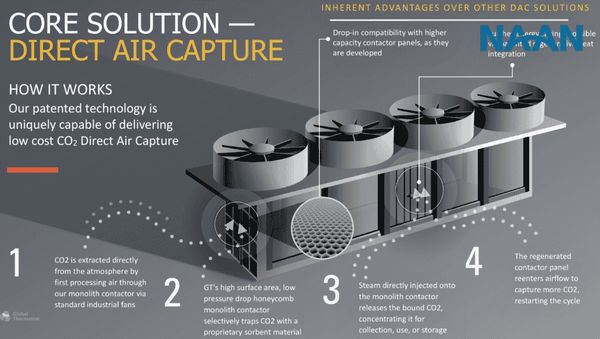
Direct Air Capture involves machines that extract carbon dioxide (CO₂) directly from the atmosphere. Using chemical processes, these systems capture CO₂ molecules, concentrate them, and store them securely, either underground or in usable materials.
Real-world example:
Climeworks, a leader in DAC technology, operates the Orca plant in Iceland. The facility captures CO₂ from the air and mineralises it in basalt rock formations, where it remains locked away for millennia.
Another example is Reactive Surfaces, a company producing coating which, when exposed to sunlight, it starts photosynthesise capturing and fixing carbon from the atmosphere. Beth McDaniel, co-founder and President talked about their approaches and solutions in episode 276I on the What is The Future for Cities? podcast – mentioning that such technologies are not just good for the planet and on Earth, but will be useful in our endeavours to discover the universe.
Advantages:
- Can operate independently of location, as CO₂ is evenly distributed in the atmosphere.
- Provides a scalable solution to directly address accumulated emissions.
Challenges:
- High energy demand, although advancements in renewable energy integration are helping to address this.
- Current costs are relatively high, but economies of scale and technological innovation are expected to reduce expenses over time.
2. Enhanced Weathering
How it works:
This method accelerates natural processes in which silicate rocks react with CO₂ in the atmosphere, forming stable carbonate minerals. Enhanced weathering involves grinding rocks like basalt into fine particles and spreading them on land or in the ocean to increase their surface area for faster reactions.
Applications:
- Agriculture: Rock dust can improve soil health while capturing carbon.
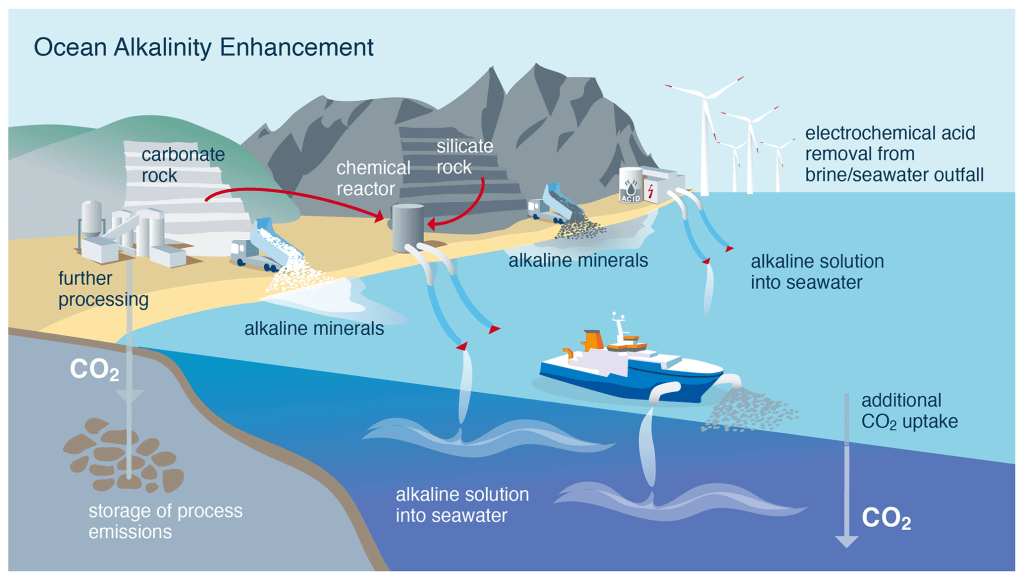
- Coastal and marine environments: Spreading reactive minerals to enhance ocean alkalinity.
Advantages:
- Dual benefits of carbon capture and improved soil fertility.
- Long-term and stable sequestration of CO₂ in mineral form.
Challenges:
- Requires large-scale mining, grinding, and transport of rocks, which could have environmental impacts.
- Limited public awareness and acceptance of the technology.
3. Ocean-Based Carbon Removal
The world’s oceans are a massive carbon sink, absorbing about a quarter of human-made CO₂ emissions annually. Emerging technologies aim to enhance this natural ability while avoiding harm to marine ecosystems.
Key methods:
- Alkalinity enhancement: Adding substances like crushed olivine to seawater increases the ocean’s capacity to absorb CO₂.
- Electrochemical processes: Companies like Equatic use electrical currents to transform CO₂ in seawater into stable forms that can be sequestered.
Advantages:
- Targets the vast carbon sequestration potential of oceans.
- Often integrates with renewable energy systems, such as offshore wind farms, to minimise energy use.
Challenges:
- Potential ecological risks if interventions alter marine chemistry too drastically.
- Requires extensive research to ensure scalability and environmental safety.
4. Mineralisation
How it works:
Mineralisation involves reacting CO₂ with naturally occurring minerals to form stable carbonates. This mimics a natural process but accelerates it through engineered solutions.
Applications:
- Underground storage: Injecting CO₂ into basalt rock formations, where it reacts to form solid carbonates.
- Building materials: Companies like CarbonCure inject captured CO₂ into concrete during production, where it permanently mineralises.
Advantages:
- Stable and long-term storage solution with minimal risk of CO₂ leakage.
- Potential to integrate with construction industries, creating sustainable building materials.
Challenges:
- Geographical limitations, as not all regions have suitable rock formations for underground storage.
- High upfront costs for infrastructure and research.
5. Carbon Capture and Storage (CCS)
How it works:
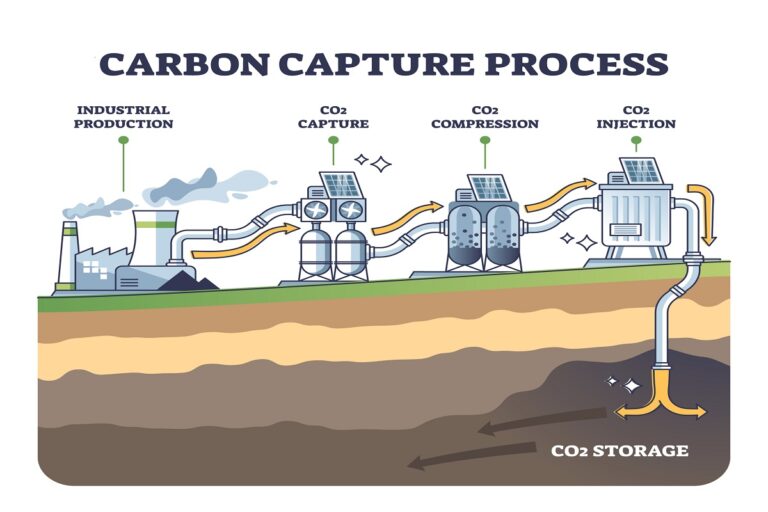
CCS captures CO₂ emissions directly from industrial facilities, such as power plants or factories, before they are released into the atmosphere. The captured CO₂ is then transported and stored underground in geological formations.
Applications:
- Heavy industries like steel and cement production.
- Fossil fuel power plants transitioning to cleaner energy systems.
Advantages:
- Prevents emissions at their source, particularly for industries that are hard to decarbonise.
- Well-established storage techniques, such as injecting CO₂ into depleted oil and gas reservoirs.
Challenges:
- High costs for capture, transport, and storage infrastructure.
- Public concerns about the safety of long-term underground storage.
Why Both Paths Are Essential
While each of these technologies offers unique advantages, no single solution can address the scale of the climate crisis alone. A combination of these emerging technologies, along with policy support, investment, and public awareness, will be essential to achieving meaningful carbon removal.
International competitions like the XPRIZE Carbon Removal are catalysing innovation by offering financial incentives to scalable and cost-effective solutions. Similarly, partnerships between governments, research institutions, and private companies are accelerating advancements in these fields.
By supporting these technologies and integrating them into broader climate strategies, we can unlock the potential to not only slow but also reverse the effects of climate change.

The climate crisis requires a dual approach: reducing emissions through cleaner technologies and actively removing carbon dioxide from the atmosphere. Net-zero goals, while necessary, are insufficient on their own to address the scale of the problem. Transitioning to clean technologies allows us to maintain our quality of life while cutting emissions, with innovations in renewable energy, transportation, and building design leading the way.
At the same time, carbon removal is essential to tackle the accumulated greenhouse gases already warming our planet. Nature-based solutions like reforestation and advanced technologies, such as direct air capture, biochar, and enhanced weathering, provide scalable options for carbon sequestration. These methods must work in tandem with clean technologies to create a sustainable, balanced approach to climate change.
Now is the time to embrace innovation and collaboration to fight climate change effectively. Here’s how you can contribute:
- Learn and Support: Educate yourself about emerging carbon removal technologies and support their development through advocacy or investment.
- Adopt Sustainable Practices: Transition to cleaner energy sources, reduce waste, and adopt sustainable practices in your personal and professional life.
- Engage in Conversations: Share ideas and discuss the role of these solutions with your community, colleagues, or policymakers to inspire action.
Consider these questions to spark further dialogue:
- How can we ensure equitable access to clean technologies and carbon removal solutions across all regions?
- What steps can industries take to scale these technologies without unintended environmental impacts?
- How can individuals influence policy to prioritise and fund carbon sequestration research?
By taking these steps, we can move beyond net-zero aspirations and build a resilient, carbon-negative future—one where innovation and sustainability thrive hand in hand. Let’s get started!
 Vitruvian Solutions
Leave a comment